
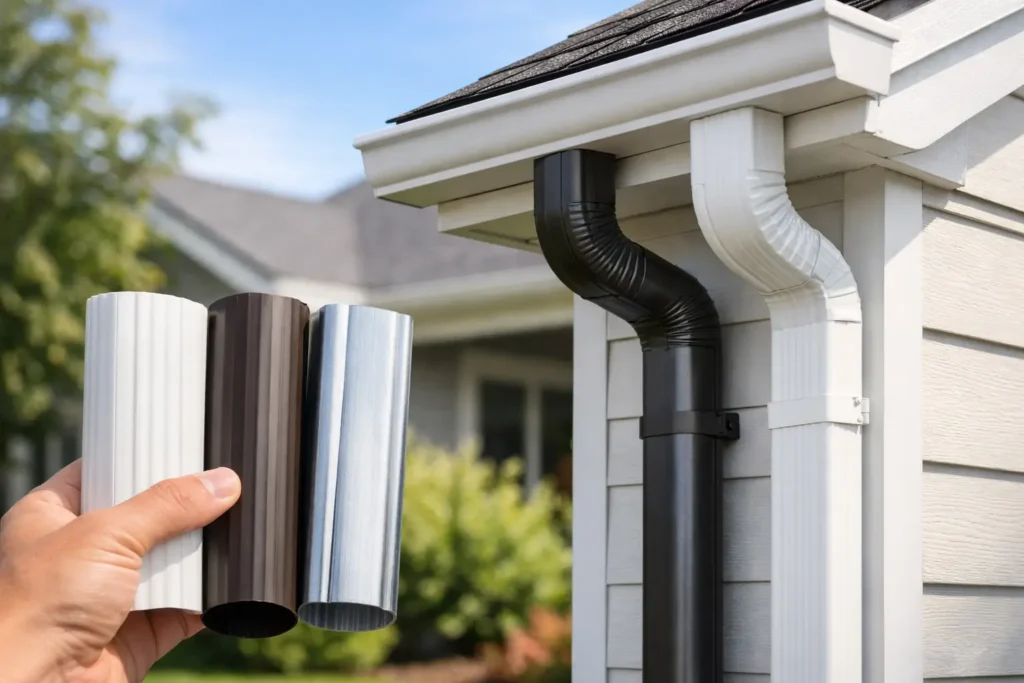
A downspout may look like a simple vertical pipe, but it has a serious job: moving roof runoff safely away from your home. When it is too small, poorly placed, or discharged too close to the foundation, water can overflow gutters, soak siding, erode landscaping, and find its way into places it does not belong. In Southern Alberta, where heavy rain, spring snowmelt, wind, and freeze-thaw conditions can all challenge an exterior system, knowing how to select gutter downspouts is part of protecting the investment you have made in your home.
The best choice is not always the biggest or most expensive option. A properly designed downspout system needs to match your roof area, gutter capacity, home layout, climate, and drainage conditions. Here is what homeowners should consider before replacing or adding downspouts.
Start With Roof Area and Water Volume
Your roof determines how much water your gutters and downspouts must handle. A large roof can shed a surprising amount of water during a fast-moving storm. Steep roof sections also move runoff quickly, placing added demand on the gutter system below.
As a general rule, a larger roof plane needs either larger downspouts or more of them. A small ranch-style home may perform well with standard 2-by-3-inch downspouts, while a larger home, a steep roof, or a roof section that concentrates water in one area may need 3-by-4-inch downspouts. The larger size carries substantially more water and is often a practical upgrade when standard downspouts have a history of overflowing.
Do not judge capacity by the number of downspouts alone. Two downspouts can still be inadequate if they are serving long gutter runs or large roof sections. The goal is to give water enough exit points so it does not back up over the gutter edge during heavy rain or snowmelt.
How to Select Gutter Downspouts by Size
Downspout size should work with the size and profile of your gutters. Standard 5-inch K-style gutters are commonly paired with 2-by-3-inch downspouts, but this pairing is not right for every home. If gutters regularly overflow despite being clean and properly pitched, the downspouts may be undersized, too few, or poorly positioned.
A 3-by-4-inch downspout is often worth considering when your home has broad roof areas, long gutter spans, metal roofing, valleys that direct large amounts of water to one location, or repeated overflow concerns. Metal roofs can shed water and snow quickly, so drainage components need thoughtful sizing and secure installation.
Round downspouts are another option, particularly on homes with half-round gutters or a more traditional exterior style. They can be attractive, but capacity and compatibility matter more than appearance. A contractor can calculate the effective drainage area of each roof section and recommend sizes that suit the system rather than relying on a one-size-fits-all approach.
Choose a Material That Fits Your Home and Climate
Most residential downspouts are made from aluminum, steel, vinyl, or copper. Each has advantages, and the right choice depends on budget, appearance, and local weather exposure.
Aluminum is a popular choice because it is lightweight, rust-resistant, and available in many colors. It works well with seamless aluminum gutters and offers dependable performance with minimal maintenance. For many homeowners, it provides the best balance of cost, durability, and curb appeal.
Steel downspouts are stronger and can handle accidental impact better than thinner aluminum, but damaged coatings can eventually lead to rust. Vinyl does not rust and is inexpensive, though it can become brittle in very cold weather and may not offer the same long-term appearance or strength as metal.
Copper is durable and distinctive, but it comes at a significantly higher cost and develops a natural patina over time. It is usually selected for architectural character rather than simple utility. Whichever material you choose, make sure the downspouts, elbows, outlets, and fasteners are compatible. Mixing materials without considering expansion, corrosion, and appearance can create avoidable problems.
Place Downspouts Where Water Naturally Collects
Location is just as important as size. Downspouts should be positioned to serve the roof’s natural drainage paths, especially beneath valleys and at the ends of long gutter runs. A roof valley can deliver a concentrated sheet of water during a storm, so it often needs a nearby downspout or a larger-capacity outlet.
Avoid placing every downspout at the same side of the house simply because it is convenient. That approach may send too much water into one section of the yard or near one portion of the foundation. Instead, distribute runoff so it can be directed safely across the property.
Downspouts should also avoid discharging onto walkways, driveways, entry areas, or neighboring properties. In cold weather, runoff can freeze and create a slip hazard. Water should be managed with the full property in mind, including grading, landscaping, window wells, patios, and any existing drainage features.
Plan for Safe Discharge Away From the Foundation
A downspout does not finish its work when it reaches the ground. It must carry water far enough away that runoff cannot pool against the foundation. Extensions, splash blocks, buried drain lines, and carefully graded soil can all help direct water where it belongs.
A simple extension is often effective when the yard slopes away from the house and there is a clear place for water to drain. It should be long enough to move runoff beyond the foundation zone without becoming a tripping hazard or an obstacle when mowing. Decorative splash blocks can help prevent soil erosion, but they are not a substitute for proper slope and adequate distance from the home.
Buried drainage piping can offer a cleaner appearance and keep water away from high-traffic areas. However, it must be installed with the correct slope, a reliable discharge point, and protection against clogging or freezing. A buried line that holds water or ends too close to the foundation can be worse than a visible extension.
Consider Leaf Protection, Snow, and Maintenance Access
Downspouts need occasional attention, even when gutters are protected by guards. Leaves, seed pods, roofing granules, and windblown debris can collect at outlets and elbows. Choose a setup that can be inspected and cleaned without unnecessary difficulty.
Where trees are close to the home, gutter guards may reduce debris buildup, but product quality and installation matter. Some guards can restrict water entry during intense rain if they are poorly matched to the roof and gutter profile. Others make cleaning more difficult if debris accumulates on top. The right solution depends on the type of trees, roof pitch, and amount of debris your home receives.
Snow and ice also deserve attention. Downspouts should be firmly fastened to the exterior so they can withstand wind, ice buildup, and seasonal movement. Loose straps, crushed elbows, and detached extensions are small issues that can quickly turn into water-management problems.
Match the Downspout Color and Style to the Exterior
Downspouts are visible, so appearance matters. Most homeowners choose a color that blends with the siding, trim, or gutters. Matching the gutters creates a coordinated look, while matching the siding can make downspouts less noticeable from the street.
There is a practical side to color selection as well. A factory-finished metal downspout generally holds its color better than a field-painted surface that may chip or peel over time. If you are replacing siding, soffit, fascia, or gutters at the same time, coordinating the entire exterior system can produce a cleaner result and prevent mismatched components later.
Know When an Upgrade Is Needed
Frequent gutter overflow, water stains on siding, soil washout, damp basement walls, and standing water near the foundation are all signs that your current downspouts may not be doing enough. Cleaning the gutters is a good first step, but persistent issues often point to an undersized system, inadequate placement, poor slope, or an unsuitable discharge route.
A professional exterior assessment can identify whether the problem starts at the roofline, in the gutter run, at the outlet, or on the ground below. HighLow Roofing & Exteriors helps homeowners look at the entire water-management system so repairs and replacements support long-term protection, not just a short-term fix.
A well-chosen downspout system should disappear into the routine of homeownership. When the next hard rain or spring thaw arrives, the best result is simple: water moves where it should, and your home stays dry, protected, and ready for the season ahead.