
A few inches of snow on the roof can look harmless. Then temperatures swing, meltwater starts moving, and suddenly you have water backing up under shingles, stained ceilings, and a repair bill that could have been avoided. If you are wondering how to prevent ice dams, the real answer starts inside the house as much as it does on top of it.
Ice dams form when heat escapes through the attic and warms the roof deck unevenly. Snow melts over the warmer sections of the roof, runs down toward the colder eaves, and refreezes there. Over time, that ridge of ice blocks proper drainage. Water then pools behind it and can work its way under roofing materials, into soffit and fascia, and eventually into insulation, drywall, and framing.
In Southern Alberta, that freeze-thaw cycle can be especially hard on homes. A roof does not need to be old or obviously damaged to develop ice dams. It just needs the right mix of heat loss, snow cover, and cold edges.
How to prevent ice dams starts with attic heat control
Most homeowners first notice ice dams at the roofline, but the source is often in the attic. Warm air from the living space rises and finds its way upward through ceiling penetrations, attic hatches, recessed lights, bath fan housings, and poorly sealed joints. Once that heat reaches the underside of the roof, it changes how snow melts.
That is why insulation alone is not always enough. If air leakage is still happening, warm air can bypass insulation and create hot spots on the roof. A well-performing attic usually needs both proper air sealing and enough insulation depth to slow heat transfer.
The right insulation level depends on the home, the attic design, and what is already in place. Older homes often have patchy coverage or compressed insulation that no longer performs the way it should. Newer homes can still have trouble if details around penetrations were missed during construction. If you have uneven snow melt, recurring icicles, or cold rooms paired with high heating bills, that is a sign to look deeper.
Ventilation matters, but it has to work with insulation
Good attic ventilation helps keep the roof deck cold and consistent. That reduces uneven melting and lowers the chance of water refreezing at the eaves. In simple terms, outside air should be able to enter low, usually through soffit vents, and exit high through roof vents or ridge vents.
The catch is that ventilation only works when airflow is not blocked. We often see soffit vents clogged by insulation or attic configurations that do not allow balanced intake and exhaust. In those cases, homeowners may think they have ventilation because vents are present, but the system is not actually moving air the way it should.
There is also a trade-off here. More ventilation does not fix major heat loss on its own. If warm interior air is leaking into the attic, ventilation can only do so much. The best results come when air sealing, insulation, and ventilation are treated as one system instead of separate fixes.
Watch the eaves, soffit, and fascia
Ice dams tend to build at the colder roof edge, which makes soffit and fascia more important than many people realize. If these areas are aging, poorly ventilated, or already water-damaged, they can become part of the problem. Sound exterior trim and properly functioning soffit ventilation help support the roof system and improve airflow where it matters most.
If you see peeling paint, soft wood, staining, or sagging near the roof edge, it is worth getting that checked before winter turns a minor weakness into a larger repair.
Keep roof drainage moving before snow arrives
One of the most practical ways to reduce risk is to make sure meltwater has a clear path off the roof. Clogged gutters do not create ice dams by themselves, but they can make the situation worse by trapping water right where freezing is most likely.
Gutters should be cleaned before winter so leaves, granules, and debris are not blocking flow. Downspouts should discharge properly and not hold standing water. If sections are loose, pitched incorrectly, or pulling away from the home, they should be corrected. When drainage is working well, water is less likely to sit at the edge and contribute to ice buildup.
This is also where the condition of the roof surface matters. Damaged shingles, lifted flashing, and worn roof edges create easier entry points if water backs up. Preventing ice dams is partly about limiting the amount of backup, but it is also about making sure the roof can resist intrusion if some backup occurs.
Snow removal can help, but it is not a full solution
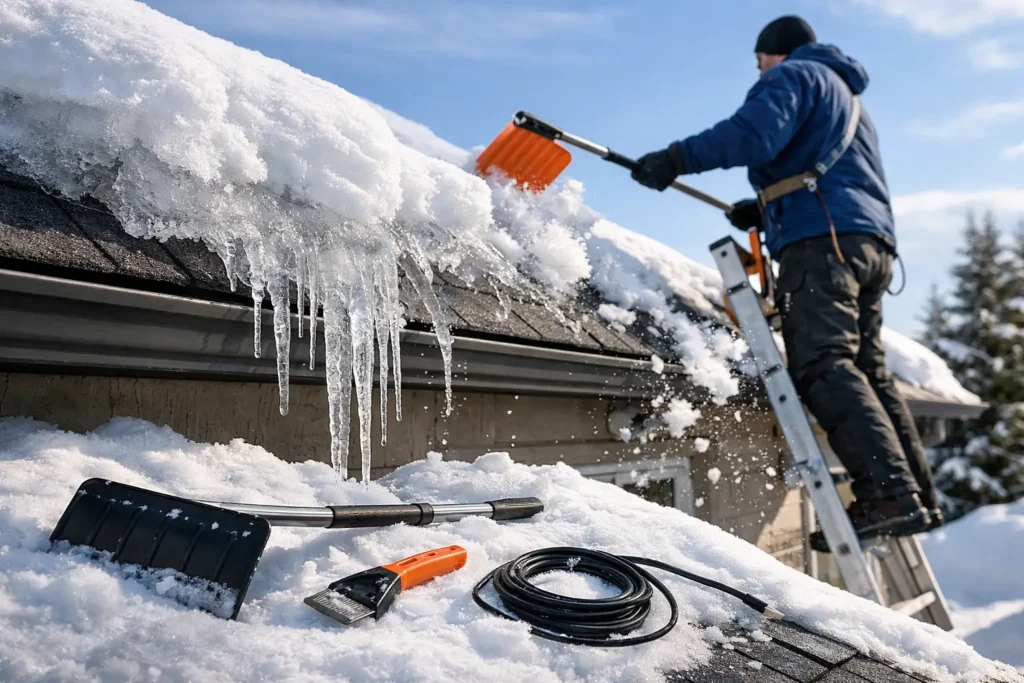
Homeowners often ask whether they should rake snow off the roof. In some cases, removing excess snow from the lower few feet of the roof can reduce the chance of buildup at the eaves. It can be a helpful short-term step, especially after heavy snowfall followed by warming and refreezing.
But it is not a cure for the root cause. If heat loss is still warming the roof, the problem will return. There is also some risk involved. Aggressive snow removal can damage shingles, and getting on an icy roof is never worth it for a DIY attempt.
If you use a roof rake, stay on the ground, use gentle downward pulls, and avoid scraping directly against the roofing material. Think of it as a way to lower immediate pressure, not as the main strategy.
Ice and water protection under the roof surface matters too
Even well-maintained homes can face severe winter conditions, so roof assembly details matter. One important layer is the waterproof membrane installed beneath shingles along vulnerable roof areas. This helps protect the home if water backs up under the outer roofing material.
It is not a substitute for insulation or ventilation, but it adds an important line of defense. If a roof is older, nearing replacement age, or has had previous leak issues near the eaves, this is something worth discussing during a roof inspection. The best time to improve underlayment protection is usually during reroofing, not after damage appears.
When roof design plays a role
Some roofs are more prone to ice dam issues than others. Complex rooflines, valleys, low-slope sections, large north-facing areas, and homes with additions can all create uneven temperature zones. Skylights, chimneys, and transitions between heated and unheated spaces can do the same.
That does not mean the roof is defective. It means prevention may need to be more targeted. One area may need better insulation above a specific room, while another may need improved ventilation or drainage changes. This is why a one-size-fits-all answer rarely works.
Warning signs you should not ignore
Icicles alone do not always mean you have a serious ice dam problem, but they should get your attention. Large or recurring icicles often suggest that heat is escaping and meltwater is refreezing at the edge.
Other warning signs are more urgent. Water stains on ceilings, frost in the attic, damp insulation, peeling paint near exterior walls, or a thick ridge of ice at the eaves all point to active trouble. If you notice shingles lifting after winter or repeated gutter icing in the same area, that is worth evaluating too.
Waiting until spring can make things harder to diagnose because the visible ice is gone while moisture damage remains hidden.
The best long-term approach to how to prevent ice dams
The most effective plan is usually a combination of improvements rather than a single repair. For one home, that may mean air sealing and adding attic insulation. For another, it may involve correcting blocked soffit intake, replacing worn roof edge materials, and upgrading underlayment during a roof replacement.
If your home has dealt with ice dams more than once, it is worth looking at the whole exterior system. Roofing, ventilation, gutters, soffit, and fascia all work together. When one part underperforms, the others carry more risk.
That is why many homeowners benefit from having the issue assessed by a contractor who understands winter roof behavior, not just visible surface damage. HighLow Roofing & Exteriors works with homeowners who want practical solutions that protect the home now and add long-term value, especially in climates where winter exposes every weak point.
A good prevention plan should leave you with fewer surprises, better energy performance, and more confidence when the next cold snap hits. If your roof has a history of heavy icicles, edge icing, or winter leaks, the right time to address it is before the next storm, not after water finds its way inside.