
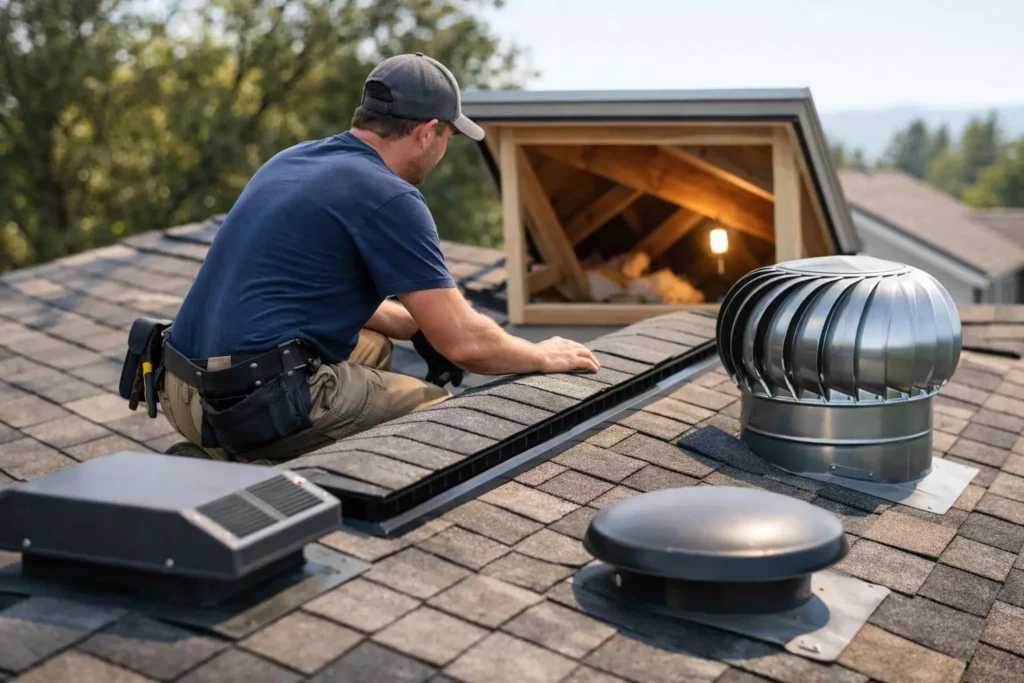
If your upstairs feels stuffy in summer, your insulation seems damp in winter, or you keep seeing ice buildup along the roof edge, the attic may be part of the problem. Homeowners often ask how to improve attic ventilation after they notice rising energy bills or premature roof wear, but the warning signs usually start earlier and get worse over time.
Why attic ventilation matters more than most homeowners think
Your attic is not supposed to trap heat and moisture. It needs steady airflow so hot, humid air can escape and fresh outside air can move in. When that balance is missing, the problems tend to show up across the whole home, not just above the ceiling.
Poor ventilation can shorten the life of roofing materials, contribute to mold and mildew, reduce insulation performance, and make your HVAC system work harder. In a place like Southern Alberta, where homes deal with temperature swings, snow, wind, and dry spells, attic performance matters even more. A roof system has to handle more than rain. It has to manage heat, moisture, and seasonal stress without breaking down early.
That is why ventilation should never be treated as an afterthought. It is part of the roof system, and when it is designed properly, it protects both the structure and your investment.
How to improve attic ventilation the right way
The most effective way to improve attic ventilation is to think in terms of balance, not just adding more vents. Many homeowners assume the fix is as simple as cutting in a few extra openings, but too much exhaust without enough intake can create weak airflow. The same goes for intake without a clear path for air to exit.
A healthy attic usually depends on a continuous cycle. Cool air enters through intake vents, often at the soffits. Warm, moist air rises and exits through exhaust vents near the ridge or high on the roof. When both parts work together, air moves through the attic instead of sitting still.
If one part of that system is blocked, undersized, or missing, ventilation suffers.
Start by checking your intake ventilation
In many homes, the biggest issue is not a lack of roof vents. It is blocked soffit ventilation. Insulation can shift and cover the openings where air is supposed to enter. Paint, debris, or aging materials can also reduce airflow.
That means your first step is often to confirm whether outside air can actually get into the attic. If soffit vents are present, they need to be open and unobstructed. In some cases, attic baffles are needed to keep insulation from pressing against the roof deck and closing off the air channel.
This is one of the most common and most fixable ventilation problems. It is also one that gets missed when people focus only on what they can see from the roofline.
Make sure exhaust vents are doing their job
Once intake is working, the attic needs a reliable way to release hot air and moisture. Ridge vents are a common solution because they run along the peak of the roof and allow warm air to escape evenly. Box vents, roof louvers, or other high-mounted vents may also be used depending on the roof design.
The key is compatibility. Mixing vent types without a plan can disrupt airflow instead of improving it. For example, if one exhaust vent pulls air from another nearby vent rather than from the soffits, the attic may still have stagnant areas. More hardware does not always mean better performance.
This is where professional evaluation matters. The right setup depends on the roof shape, attic size, insulation levels, and how the home was originally built.
Signs your attic ventilation may be failing
Some ventilation issues are obvious, but many look like separate home maintenance problems at first. If you are trying to figure out whether your attic needs attention, a few patterns are worth watching.
A very hot upper floor in summer can point to trapped attic heat. Frost on nails or damp roof decking in colder months can suggest moisture buildup. Peeling paint near soffits, recurring ice dams, musty smells, and shingles that seem to age too quickly may also be connected to poor airflow.
Not every symptom means ventilation is the only issue. Roofing age, insulation levels, air leaks from the living space, and weather exposure all play a role. Still, when several of these signs show up together, the attic deserves a closer look.
Ventilation and insulation need to work together
One of the biggest mistakes homeowners make is treating insulation and ventilation as separate projects. They are closely connected. Better insulation helps reduce heat loss from the home, while proper ventilation helps manage the attic environment above it.
If insulation is added without preserving airflow at the eaves, soffit intake can get blocked. If ventilation is improved without addressing major air leaks from the house into the attic, moisture can still build up. Good performance comes from the whole system working together.
That is also why attic problems can be frustrating to diagnose from inside the house. You may notice comfort issues or higher utility costs, but the real cause is often a mix of air sealing, insulation, and ventilation rather than one isolated failure.
Moisture control is a major reason to improve attic ventilation
Heat gets most of the attention, but moisture is often the more damaging issue. Everyday household activities like cooking, showering, and laundry create indoor humidity. If that warm air leaks into the attic and cannot escape, condensation can form on cold surfaces.
Over time, that can lead to staining, wood deterioration, mold growth, and a drop in insulation effectiveness. In winter, the risk becomes more serious because warm attic temperatures can melt snow on the roof, which then refreezes at the colder edges and contributes to ice damming.
That is one reason homeowners should not wait until there is visible damage. By the time moisture marks show up, the attic may already have a longer history of poor performance.
When a ventilation upgrade makes the most sense
If your roof is already being repaired or replaced, that is often the best time to correct ventilation issues. Access is easier, materials can be integrated properly, and the full system can be assessed instead of patched together in stages.
That said, you do not always need a full roof replacement to improve attic ventilation. Sometimes the right fix is clearing soffits, installing baffles, adding balanced exhaust vents, or correcting a bad vent layout from an earlier job.
It depends on the age of the roof, the condition of the attic, and how severe the airflow problem is. A newer roof with poor vent design may only need targeted improvements. An older roof with worn materials and moisture damage may call for a broader solution.
Common mistakes homeowners should avoid
Trying to improve attic ventilation without understanding the existing system can create new problems. Powered attic fans, for example, may sound like a quick answer, but in some homes they can pull conditioned air from the living space if air sealing is weak. That can increase energy loss rather than reduce it.
Another common issue is covering soffit vents during insulation upgrades or replacing roofing materials without updating ventilation to match current needs. Even a well-built roof can underperform if airflow was overlooked.
The safest approach is to treat ventilation as part of your roof and exterior protection strategy, not as a stand-alone add-on.
A practical way to assess your attic
If you are wondering what to do next, start with a straightforward inspection mindset. Look for signs of blocked soffits, uneven attic temperatures, damp insulation, mildew, frost, or visible staining on the underside of the roof deck. Pay attention to whether the home feels harder to cool in summer or whether ice dams return each winter.
From there, the best next step is usually a professional roof and attic evaluation. An experienced contractor can determine whether the issue is ventilation, insulation, air leakage, or a combination of all three. That matters because the right fix is rarely one-size-fits-all.
For homeowners in Lethbridge and surrounding Southern Alberta communities, local weather makes that experience especially valuable. Wind exposure, winter conditions, and seasonal temperature changes all affect how an attic should be vented and protected.
A good ventilation upgrade is not about adding the most vents. It is about giving your roof system a clear, balanced path to breathe so your home stays drier, more efficient, and better protected for the long haul.