
Last Updated: November 4, 2026
Quick Summary
The best material for alberta roofs depends on how it handles Southern Alberta’s hail, wind, deep cold and heavy snow over many winters. Asphalt shingles are the most common and cheapest upfront but last shortest, metal roofing lasts longest and sheds snow well, and impact-resistant shingles address hail risk.
- Standard asphalt shingles have the lowest upfront cost but a shorter service life.
- Metal roofing sheds snow well and resists wind uplift when properly fastened.
- Check the manufacturer’s published impact-resistance classification, not just the brand, when comparing hail-resistant shingles.
- Ventilation, underlayment and flashing affect roof performance as much as the material on top.
- Get a roof inspection before replacement to confirm deck condition and ventilation needs.
Table of Contents
- How Alberta Weather Shapes Roofing Choices
- Asphalt Shingles Lifespan Alberta Homeowners Can Expect
- Metal Roofing Pros and Cons in Alberta
- Hail-Resistant Shingles Alberta Roofs Should Consider
- Comparing Roofing Materials Side by Side
- Why Roof Inspection Before Replacement Matters
- Booking a Roof Assessment With HighLow Roofing & Exteriors
- Frequently Asked Questions
How Alberta Weather Shapes Roofing Choices
Choosing a roof for alberta roofs in Southern Alberta means planning for hail, wind, deep cold and heavy snow. The right material depends on how it handles these conditions over many winters, not just how it looks on installation day.
Southern Alberta sees sharp temperature swings, strong winds and hail events that can strike with little warning. Roofing material has to resist impact, shed water and snow, and hold up through repeated freeze-thaw cycles. Each of these factors pushes the choice in a different direction.
Start with your home’s exposure. A house on an open lot takes more wind than one sheltered by trees or neighbouring buildings. Roof slope also matters, since steeper roofs shed snow more readily than low-pitched ones. Note the age of your home and its current structure, because some materials add significant weight.
Asphalt Shingles Lifespan Alberta Homeowners Can Expect
Asphalt shingles remain the most common roofing choice in the province. Their lifespan depends heavily on quality, installation and ventilation. The lifespan of asphalt shingles depends heavily on quality, installation and ventilation.
Pay attention to the warning signs. Curling, cracked or missing granules, and dark patches that hold moisture all suggest the shingles are nearing the end of their useful life.
Ventilation is one of the most overlooked factors. Poor airflow in the attic traps heat in summer and moisture in winter, which shortens shingle life from underneath. Ask your contractor to check attic ventilation as part of any replacement.
Metal Roofing Pros and Cons in Alberta
Metal roofing has become a popular option for homeowners who want durability and snow shedding. Its smooth surface lets snow slide off more easily, which can reduce ice build-up at the eaves in some designs. Metal also resists wind uplift well when it is properly fastened.
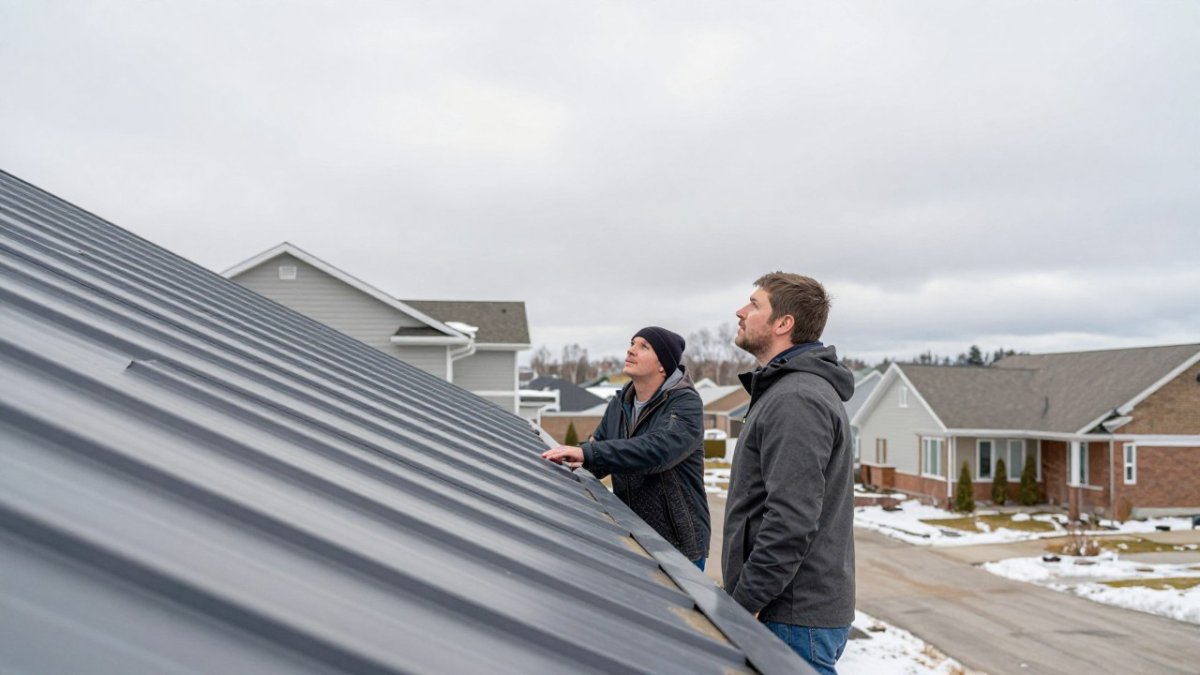
!A homeowner and a roofing contractor standing in a residential driveway in Southern Alberta, looking up at a metal roof under an overcast winter sky
The drawbacks are worth weighing honestly. Metal roofs cost more upfront than asphalt shingles, and they can be louder during hailstorms unless the underlayment and decking are sound. Some profiles also show dents more readily, which matters if cosmetic appearance is a priority.
Consider the pros and cons together:
- Pros: long service life, good snow shedding, strong wind resistance, low maintenance
- Cons: higher upfront cost, possible noise in hail, cosmetic denting on some profiles
Hail-Resistant Shingles Alberta Roofs Should Consider
Hail is one of the biggest risks to roofs across the region, and impact-resistant shingles are the most common answer. The useful question is not whether a shingle is “hail resistant” but which rating it carries and what that rating actually tested.
When you compare products, ask for the manufacturer’s published impact-resistance classification and the specific product line, not just the brand.
Insurance treatment of impact-resistant roofing varies by provider and policy. Confirm the terms with your insurer before you choose a product on the assumption of savings, and ask what documentation they require.
Other factors affect hail performance as much as the shingle. Underlayment quality, deck condition, fastener pattern, and ventilation all influence how the roof behaves under impact and how it dries if water gets in. A strong rating paired with poor installation can still leave a roof vulnerable, so treat the rating as one input in the decision, not the decision itself.
Comparing Roofing Materials Side by Side
The table below summarizes how the most common options compare on the factors that matter most here. Figures are typical ranges for planning purposes, not quotes, actual numbers depend on roof size, pitch, access, deck condition, and the contractor. For a broader side-by-side look at cost, maintenance and Southern Alberta weather performance, see the full materials guide.
| Material | Typical service life | Hail performance | Snow shedding | Relative upfront cost | Long-term notes |
|---|---|---|---|---|---|
| Standard asphalt shingles | About 15-25 years | Varies by product; not rated | Moderate | Lowest | Lowest upfront; shortest life; most frequent replacement |
| Impact-resistant (Class 4) shingles | About 20-30 years | Class 4, rating-dependent | Moderate | Moderate | Higher upfront than standard; may qualify for insurance considerations |
| Metal roofing | About 40-60 years | Good; some profiles dent | Strong | Highest | Highest upfront; lowest maintenance over life; check fastener and finish warranties |
| Concrete or clay tile | About 40-50+ years | Good; can crack on impact | Moderate to strong depending on profile | High | Heavy, structural review needed; fewer local installers |
Upfront cost and lifecycle cost are different questions, and the cheapest installation is not always the lowest cost over the life of a roof.
Material choice does not stand alone. The roof assembly around it determines much of the performance:
- Underlayment: a synthetic or high-temperature underlayment is the secondary barrier when water gets past the surface material. Its quality matters as much as the shingle or panel above it.
- Ice-and-water protection: membrane at the eaves and in valleys is standard practice in cold climates and is a common requirement in local building practice.
- Ventilation: balanced intake and exhaust keeps the attic dry and extends the life of nearly every material. Poor ventilation shortens shingle life from underneath and can trap moisture under metal.
- Flashing: chimney, skylight, and wall flashing are the most common leak points regardless of material. Details matter more than the product name.
- Deck condition: soft or delaminated decking undermines any new roof. Confirm the deck is sound before choosing a material.
Structural weight is the other constraint. Asphalt shingles are relatively light; metal is comparable or lighter depending on profile; concrete and clay tile are substantially heavier and may require a structural review before installation. If your home was built for a lighter material, that limits your options more than budget does.
Use the comparison as a starting point, then narrow by your own priorities: budget for installation and long-term maintenance, roof slope and structure, local hail and wind exposure, insurance implications, and how long you plan to stay in the home. Request written specifications and ratings for any product you are considering, and compare them against those priorities rather than against a single headline number.
Why Roof Inspection Before Replacement Matters
A proper inspection can show the actual scope of work. It can reveal whether the decking is sound, whether ventilation needs upgrading and whether the damage is isolated or widespread.
An inspection also protects you from paying for work you do not need. A contractor who documents hail impacts, flashing condition and attic moisture gives you a clear basis for deciding what to replace. Ask for photos and written findings you can review later.
Watch out: replacing shingles over a damaged deck or without fixing ventilation can trap moisture and shorten the life of the new roof. Confirm the underlying condition before you sign.
Booking a Roof Assessment With HighLow Roofing & Exteriors
If you are unsure which material suits your home, a roof assessment is the practical next step. At HighLow Roofing & Exteriors, we serve Lethbridge and Southern Alberta and can review repairs, replacements and related exterior work.
For current pricing, contact HighLow Roofing & Exteriors for a written quote tailored to your home. To see how roof replacement costs typically break down in Lethbridge, read the Lethbridge roof replacement cost guide.
Request an estimate from HighLow Roofing & Exteriors to start your assessment.
Frequently Asked Questions
What roofing material is best for Alberta weather?
No single material suits every Alberta home. Asphalt shingles are the most common choice because they are affordable and widely installed, while metal roofing sheds snow well and tends to last longer. The best option depends on your roof slope, the structure beneath it, how much hail exposure your area sees, and your budget. A roofing professional can assess those factors on your specific home before you choose.
Are metal roofs a good choice for Alberta winters?
Metal roofs handle Alberta winters well in many cases. Their smooth surface helps snow slide off, which can reduce snow load on the structure, and they resist the freeze-thaw cycles that can crack other materials. Metal can expand and contract noticeably in cold and heat, so fastening and flashing details matter. Pros and cons should be weighed against your home’s structure and budget.
Which roofing materials hold up best to hail?
Impact-resistant shingles and some metal roofing products are generally rated to hold up better to hail than standard asphalt shingles. To confirm a product’s rating, ask your roofer for the impact-resistance classification in writing and check the manufacturer’s documentation. Your homeowner’s insurance policy may also treat impact-rated roofing differently, so confirm those details with your insurer before you decide.
How long do asphalt shingles last in Alberta?
Asphalt shingle lifespan in Alberta is shortened by hail, wind, UV exposure and freeze-thaw cycles. Lifespan also depends on ventilation, installation quality and maintenance. Regular inspections help catch granule loss, lifted tabs or cracked sealant early, which can extend how long your roof performs well.
