

Last Updated: October 30, 2026
Quick Summary
Hiring one contractor for exteriors can simplify a project involving roofing, siding, and eavestroughs, since one company sequences the work and takes responsibility for the whole job. This works best when you confirm how each trade is coordinated and who supervises between them. Some specialty projects may still call for dedicated specialists.
- Ask who manages the sequence of trades and who is your day-to-day contact.
- Ask which exterior trades the contractor performs in-house and which they subcontract.
- Request recent references from projects that combined two or more exterior trades.
- Confirm liability insurance and workers’ compensation coverage with copies, not verbal assurances.
- Compare quotes on a shared, numbered scope so exclusions and allowances are visible.
Table of Contents
- Why Hiring One Contractor for Exteriors Can Make Sense
- Questions to Ask an Exterior Contractor Before You Commit
- Checking Contractor References and Credentials
- Building an Exterior Renovation Checklist
- How to Compare Exterior Renovation Quotes on an Equal Scope
- Contracts, Permits, Warranties, and Dispute Protection
- Booking Your Exterior Project With HighLow Roofing & Exteriors
- Frequently Asked Questions
Why Hiring One Contractor for Exteriors Can Make Sense
Hiring one contractor for exterior work can simplify a project that would otherwise involve several separate trades. Homeowners in Lethbridge and Southern Alberta often face the same problem: a roof leak, damaged siding, and clogged eavestroughs, all needing attention at once. Coordinating three different companies takes time, and it often leaves gaps where no one takes responsibility.
A single contractor manages the sequence of work from start to finish. Readers weighing this option can see how a combined roof and siding project is handled from start to finish. The roofing crew can finish before the siding goes up, and the eavestrough and fascia can be installed once the exterior envelope is complete. This order matters because water that gets past one trade can damage the work of another.
There are trade-offs. A single contractor may not be the best choice for every specialty, and some homeowners prefer a dedicated specialist for a large, complex project. The rest of this guide explains how to decide, and how to vet a contractor once you have chosen to go with one.
Questions to Ask an Exterior Contractor Before You Commit
Ask a potential contractor how they will handle each trade you need, and who will supervise the work between them. Compare these answers against a full local hiring guide for Lethbridge. A good answer names a project lead, explains whether their own crews do the work or subcontractors do, and describes how each subcontractor is vetted.
Other questions worth asking:
- Which exterior trades do you perform in-house, and which do you subcontract?
- Who is my day-to-day contact, and how often will I receive updates?
- How do you schedule trades so that roofing, siding, and eavestroughs do not conflict?
- What materials do you recommend for an older home, and why?
- How do you handle weather delays during the project?
- What happens if a problem appears after the work is finished?
Pay attention to vague answers. A contractor who cannot explain how they coordinate trades is unlikely to manage a multi-trade project well.
Checking Contractor References and Credentials
References show how a contractor performs on jobs similar to yours. Ask for recent references from projects that combined two or more exterior trades, and call them. Ask whether the project finished on schedule, whether the crew cleaned up, and whether any issues came up after completion.
Credentials need checking too. Confirm that the contractor carries liability insurance and workers’ compensation coverage, and ask for copies rather than verbal assurances. Check whether they hold the business licences and trade certifications required in Alberta for the work you need (Recognized trade credentials in Alberta). Your municipality can tell you which permits apply to your project.
Photos of completed work are useful, and asking to see jobs in your local area is a reasonable request. Local weather, soil, and building styles can affect how an exterior holds up over time.
Building an Exterior Renovation Checklist
Most exterior projects fail at the scope stage, not the build stage. You can start from an exterior upgrade checklist and adapt it to your home.
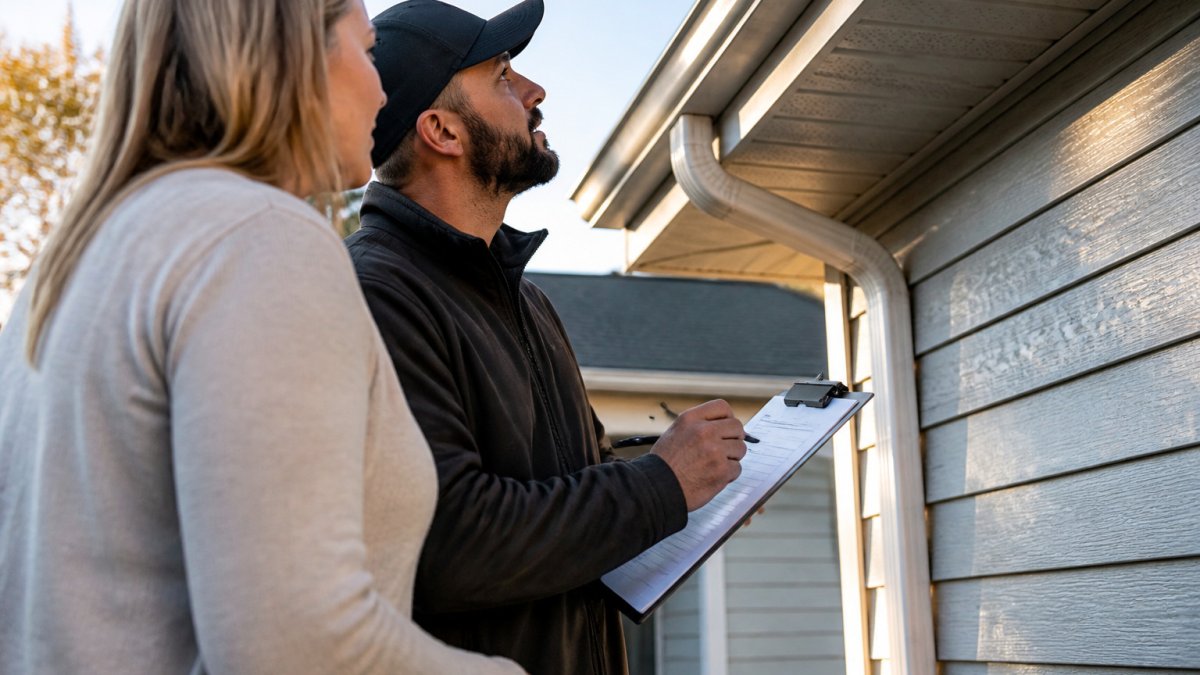
Start with a condition survey. Walk the exterior of the home and record the state of each element: roof covering, flashing, siding, soffit, fascia, eavestroughs, downspouts, doors, trim, and any deck or porch structure. Photograph each area, including close-ups of damage, staining, rot, or separation.
Then convert the survey into line items. Each line should describe one trade task, the material or product specified, the quantity or measurement, and what is included in removal and disposal.
Include these categories on the checklist:
- Scope per trade, written as measurable line items rather than descriptions
- Existing conditions and photos, with notes on anything that may require exploratory work
- Preferred materials, colours, and product grades, with model numbers where possible
- Removal, disposal, and dumpster responsibility
- Permit responsibility and who submits the application
- Access, parking, staging, and protection of landscaping and pets
- Timeline, including weather-sensitive windows and any hard deadlines
- Exclusions the homeowner will handle separately (for example, painting, gutter guards, or interior repairs)
- Payment milestones tied to completed work, not calendar dates
- Warranty expectations for materials and workmanship
Number every line item. When a contractor returns a quote, ask them to reference your line numbers so you can see exactly what is and is not included. This single habit eliminates most quote confusion.
Sequencing belongs on the checklist too. Exterior trades have a natural order: structural repairs and deck framing first, then roofing and flashing, then siding and windows, then soffit, fascia, and eavestroughs, then doors and trim, and finally cleanup and touch-ups. If a contractor proposes a different order, ask them to explain why, sometimes there is a good reason, but often it signals they have not thought through how the trades interact. Water that gets behind siding because the roof flashing was installed last will cause callbacks.
Finally, decide what you will not bundle. Some homeowners keep painting, landscaping, or interior work with separate providers to control cost or timing. Write those exclusions down so every contractor prices the same core scope. A shared, numbered checklist is the single most effective tool for getting comparable exterior quotes.
The checklist works best when it covers these categories, each of which should be written as a numbered, measurable line item.
| Checklist category | What to record | Why it matters |
|---|---|---|
| Condition survey | Roof covering, flashing, siding, soffit, fascia, eavestroughs, downspouts, doors, trim, decks | Shows the current state of each element |
| Scope per trade | Measurable line items, not descriptions | Makes contractor prices comparable |
| Permit responsibility | Who submits the application | Avoids gaps in compliance |
| Removal and disposal | Who removes and disposes of old material | Prevents hidden costs |
| Payment milestones | Tied to completed work, not dates | Protects your cash flow |
| Exclusions | Work you handle separately | Keeps the core scope consistent |
How to Compare Exterior Renovation Quotes on an Equal Scope
Quotes for exterior work rarely arrive in the same format. One contractor prices by the square, another by linear foot, a third gives a lump sum with a short description. Before you compare totals, normalize the bids against your numbered checklist so you are comparing the same work. Use these estimate questions to confirm each quote covers the same scope.
Build a comparison sheet with one row per checklist line and one column per contractor. For each row, record whether the bid includes the item, excludes it, or prices it as an allowance. Then total the included work and list every exclusion separately.
Pay close attention to three things that drive most quote differences:
- Exclusions. Ask each contractor to state in writing what is not included. Common exclusions on exterior work include decking replacement under a door threshold, rot repair behind siding, permit fees, dumpster rental, and painting or staining. An exclusion is not automatically bad, but it must be visible before you sign.
- Allowances. An allowance is a placeholder amount for a material or scope the contractor cannot price precisely until work begins, for example, a rot repair allowance or a siding allowance per square. A low allowance makes a bid look cheaper while shifting risk to you. Ask what happens if actual costs exceed the allowance, and get the unit rate in writing.
- Unit pricing. For measurable work, ask for unit rates: per square of roofing, per linear foot of eavestrough, per square foot of siding. Unit pricing lets you compare bids fairly and understand what a change order will cost before you approve it.
A bid that is significantly lower than the others is a signal to investigate, not a reason to celebrate. Ask the contractor to walk you through their scope line by line and explain what they left out. Unusually low bids often rely on skipped permits, undertrained crews, minimal insurance, or change orders later in the project.
Ask each contractor to explain their pricing in writing. Material grade, existing structural condition, access difficulty, season, and crew availability all affect the number, and a contractor who can explain those drivers is usually easier to work with when conditions change. If two bids differ by a wide margin, the reason is almost always in the scope, the materials, or the exclusions, find it before you choose.
Finally, compare the non-price terms on the same sheet: payment schedule, deposit size, start date, projected duration, warranty length, and who pulls permits. A slightly higher bid with a clearer scope, a reasonable deposit, and a written workmanship warranty is often the better value. The goal is not the lowest number, it is the most complete, comparable, and accountable bid.
Contracts, Permits, Warranties, and Dispute Protection
A written contract protects both you and the contractor. It should list the scope of work, materials, schedule, payment milestones, permit responsibilities, and cleanup expectations. Avoid paying a large deposit before work begins, and tie payments to completed milestones.
Confirm who pulls the permits. In many cases the contractor handles this, but you should verify it and keep copies for your records.
Warranties matter as much as the work itself. Ask for two types of coverage: a manufacturer warranty on materials and a workmanship warranty from the contractor. Get the length and conditions of each in writing. Also include a clear process for resolving disputes, such as a documented inspection and a timeline for corrections, so that problems do not stall the project.
Booking Your Exterior Project With HighLow Roofing & Exteriors
If you are planning a roof, siding, soffit, fascia, or eavestrough project in Lethbridge or Southern Alberta, HighLow Roofing & Exteriors can review your checklist and provide a written estimate.
Request an estimate through our website, and include your checklist and any photos of the work you want done. Follow this step-by-step path to requesting a free roofing estimate. For current pricing, contact us directly, since costs depend on the scope and condition of your home.
Frequently Asked Questions
Can one contractor handle multiple exterior renovation projects?
Yes. Some exterior contractors handle roof repairs, siding, soffit and fascia, and eavestrough work under one agreement. Coordinating these trades with one crew usually means fewer scheduling gaps, a single point of accountability, and clearer responsibility if water intrusion or a workmanship issue appears later. Confirm in writing which trades the contractor performs directly and which they subcontract, and ask who manages the sequence of work so that siding goes up after flashing is complete and eavestrough is installed after fascia is fixed.
What should I ask an exterior contractor before hiring them?
Ask how long they have operated, whether they carry liability insurance and workers’ compensation coverage, who will supervise the job on site, and what warranty they provide on both materials and labour. Ask for a written scope of work and a timeline. Request examples of similar completed projects in Southern Alberta and speak with recent clients if possible. A contractor who answers these questions clearly and in writing is usually a safer choice than one who gives vague answers or pressures you to sign quickly.
How do I compare exterior renovation quotes fairly?
Make sure every quote covers the same scope: the same materials, the same removal and disposal work, the same flashing and underlayment details, and the same warranty terms. A lower price often means a smaller scope or lower-grade materials. Line up the quotes side by side and mark any item that appears in only one of them. Ask each contractor to explain any large difference in price so you can judge whether it reflects better workmanship or missing work.
How can I check an exterior contractor’s references and credentials?
Ask for at least three recent references from projects of a similar size and type, then call them and ask about communication, schedule, cleanup, and how the contractor handled problems. Verify insurance certificates directly with the insurer rather than relying on a copy. Check that the business is registered and that the people working on your home are properly licensed for the trades they perform. Review online ratings, but read the detailed comments rather than focusing only on the star count.
