
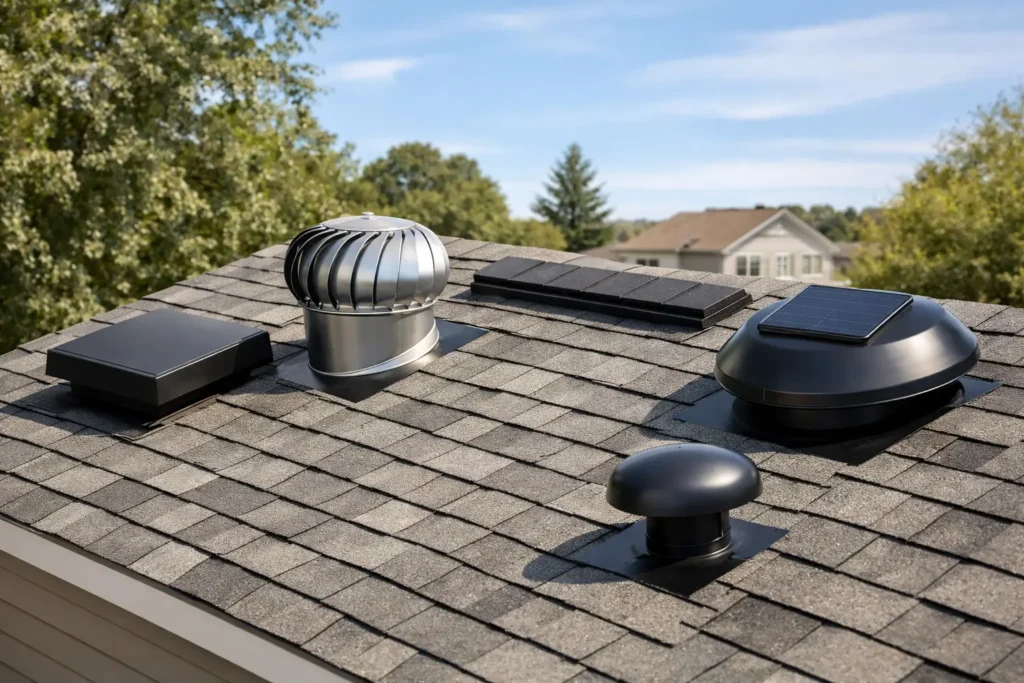
A roof can look perfectly fine from the street and still have a ventilation problem hiding in the attic. We see it often – excess heat in summer, frost buildup in winter, damp insulation, or shingles that seem to age faster than they should. Choosing the best roof vent options is not just about moving air. It is about protecting your roof system, managing moisture, and helping your home perform better year-round.
In a place with strong winds, cold winters, and big temperature swings, roof ventilation needs to do more than meet the minimum. It needs to work with your roof design, your attic layout, and your intake ventilation so the system performs as a whole.
Why roof ventilation matters more than most homeowners think
Your attic collects heat and moisture from daily life. Cooking, showers, laundry, and normal indoor humidity all push warm air upward. If that air has nowhere to go, it can condense on cold surfaces, dampen insulation, and contribute to mold, wood damage, and reduced energy efficiency.
In summer, poor ventilation can trap superheated air in the attic and put extra strain on your roofing materials. In winter, it can lead to frost and uneven roof temperatures that increase the chance of ice dam issues. Good ventilation helps regulate attic conditions, which supports shingle life, insulation performance, and overall roof health.
That is why the best roof vent options are not always the most expensive or the most visible. The right choice depends on how well the venting system matches the home.
The best roof vent options for different homes
Ridge vents
Ridge vents are one of the most effective and widely recommended choices for many homes. Installed along the peak of the roof, they allow warm, moist air to escape at the highest point of the attic. When paired with proper intake ventilation at the soffits, ridge vents create steady natural airflow across the entire attic space.
For many homeowners, this is one of the best roof vent options because it offers balanced ventilation without adding bulky vent units across the roof. It also creates a cleaner look from the curb.
That said, ridge vents are not ideal for every roof. They work best on roof designs with a long, continuous ridge and enough soffit intake to support air movement. On complicated rooflines with many hips, valleys, or disconnected attic sections, ridge vents may not ventilate every area evenly.
Box vents
Box vents, sometimes called static vents, are simple roof vents installed near the upper portion of the roof. They allow hot air and moisture to escape through natural convection. They have no moving parts, which makes them dependable and relatively low maintenance.
Box vents can be a strong choice when a roof does not have enough ridge length for ridge venting or when only one section of the attic needs added exhaust. They are also a practical option on homes with simpler ventilation upgrades.
The trade-off is that box vents are more localized. You usually need several of them to ventilate a full attic effectively, and placement matters. If they are not sized and spaced properly, airflow can be uneven.
Wind turbines
Wind turbine vents use wind power to pull hot, moist air from the attic. When they are spinning well, they can move a lot of air. In windy areas, that sounds appealing, and there are situations where they perform well.
Still, they are not always the first recommendation for long-term consistency. Moving parts can wear over time, and performance depends heavily on wind conditions and installation quality. Some homeowners also dislike the look.
In exposed areas, turbine vents may seem like one of the best roof vent options, but only if the roof system, maintenance expectations, and local conditions make sense for them.
Off-ridge vents
Off-ridge vents are similar in purpose to ridge vents but are installed slightly below the roof peak rather than directly at the ridge. They can be useful when a ridge vent is not practical because of the roof design.
They are generally less efficient than a full ridge vent system, but they can still provide effective exhaust in the right setup. For homes that need added ventilation without a major redesign, off-ridge vents can be a reasonable middle ground.
Power vents
Power vents use an electric motor to pull air out of the attic. Some models include thermostats or humidistats that trigger the fan when attic heat or moisture reaches a certain level. These vents can move a high volume of air and may help in attics with persistent heat buildup.
The downside is that power vents add mechanical complexity. They rely on electricity, have components that can fail, and may create pressure problems if the attic does not have enough intake ventilation. In some cases, they can even pull conditioned air from the living space if attic air sealing is poor.
Power vents can be effective, but they are not automatically the best solution just because they are active. A properly balanced passive system is often the better long-term choice.
Solar-powered roof vents
Solar-powered vents work much like power vents, but they use a small rooftop solar panel to run the fan. Homeowners often like the idea of active ventilation without adding to utility costs.
These can be useful in certain situations, especially where electrical access is limited. But the same caution applies as with standard power vents: if intake ventilation is not adequate, the system may not perform the way you expect. They also tend to cost more up front than passive vent options.
Gable vents
Gable vents are installed in the exterior wall at the end of the attic, near the roof peak. They can allow air to enter or leave the attic depending on wind direction and pressure differences.
On older homes, gable vents are common. They can help, but on their own they usually do not provide the same consistent, full-attic airflow as a balanced soffit-and-ridge system. They are often best viewed as part of a broader ventilation plan rather than the complete answer.
What makes one vent option better than another
The best roof vent options are not judged by the vent alone. They are judged by how the entire attic ventilation system works together.
Intake ventilation is the first piece many homeowners overlook. Exhaust vents cannot do their job properly without enough fresh air entering through the soffits or other low intake points. If you increase exhaust without balancing intake, you may create weak airflow or pressure issues instead of solving the problem.
Roof shape matters too. A simple gable roof may work beautifully with ridge vents. A more complex roof with several sections may need a combination approach. Attic insulation, air sealing, and existing moisture conditions also influence which system makes sense.
Then there is durability. In areas with snow, wind, and dramatic weather shifts, the vent has to hold up physically while still preventing water intrusion. The right installation details matter as much as the product choice.
Signs your current roof ventilation may need attention
You do not always need to climb into the attic to spot ventilation issues. Some signs show up in everyday ways. Your upstairs rooms may feel harder to cool. You may notice frost on nails or roof decking in winter, musty attic smells, damp insulation, or shingles that appear to wear unevenly.
Ice dams can also point to a bigger attic performance issue, though ventilation is only one part of that picture. Insulation and air sealing play a role too. That is why a quick guess is rarely enough. A proper roof assessment looks at the whole system.
How to choose the right option for your home
If your goal is long-term protection, the best starting point is not picking a vent from a product photo. It is understanding how your current roof breathes now and where it is falling short.
For many homes, a balanced passive system with soffit intake and ridge exhaust delivers the best mix of reliability, efficiency, and low maintenance. For others, roof design may call for box vents or a more customized approach. Older homes, additions, and complex attic layouts often need more careful planning than homeowners expect.
This is also one area where workmanship matters a great deal. Even a good vent product can underperform if it is installed in the wrong location, paired with poor intake, or added without addressing existing moisture issues. A contractor who understands roofing in real weather conditions will look beyond the vent itself and focus on how the whole roof system performs over time.
If you are weighing ventilation changes as part of a roof repair or replacement, that is often the best time to get it right. It gives you a chance to improve airflow, protect new materials, and avoid carrying old attic problems into a new roof. For homeowners who want practical guidance and a clear answer, HighLow Roofing & Exteriors approaches ventilation the same way we approach every roof system – with honest recommendations, quality workmanship, and a focus on protecting the home for the long haul.
The right vent should do its job quietly, season after season, without you having to think much about it. That is usually the best sign you made the right choice.