

Table of Contents
- Signs Gutters Need Replacing
- How Long Do Gutters Last
- Gutter Inspection Checklist
- Gutter Repair Versus Replacement: Making the Right Choice
- Planning Your Gutter Replacement
- Frequently Asked Questions
Last Updated: October 9, 2026
Signs Gutters Need Replacing
The easiest way to know when to replace your gutters is to watch for visible damage. At HighLow Roofing & Exteriors, we help homeowners spot these signs before water damage spreads to the roof, fascia, and foundation.
Most homeowners don’t inspect until a problem is obvious; by then, water has often damaged the roofline. Catching issues early saves thousands in repairs.
Cracks, Holes, and Fractures
Small cracks grow quickly, worsened by freeze-thaw cycles and debris impact.
Look for:
- Visible splits in the gutter material
- Holes you can see daylight through
- Separation at seams where sections connect
Even pencil-point holes let water escape, run down your fascia, and soak into the wood, causing rot.
Leaks and Water Overflow
Water pooling near your foundation or dripping during rain means your system is failing. Leaks come from failed seams or cracks; overflow happens when gutters clog or sag.
Check after heavy rain:
- Water spilling over the gutter edge
- Puddles forming directly below the gutters
- Wet spots on your fascia or siding
Overflow erodes soil, seeps into basements, and stains siding.
Sagging or Pulling Away from the Roof
Gutters should hang straight and level. Sagging means fasteners are loose or the structure is weakening; pulling away means the mounting system is failing.
This happens because:
- Fasteners corrode and lose grip
- The gutter material itself becomes too heavy with debris and water
- Wood fascia rots, weakening the attachment points
A sagging gutter can’t direct water properly. Water pools in low spots, adds weight, and worsens the sag until replacement becomes necessary.
Rust, Corrosion, and Pinholes
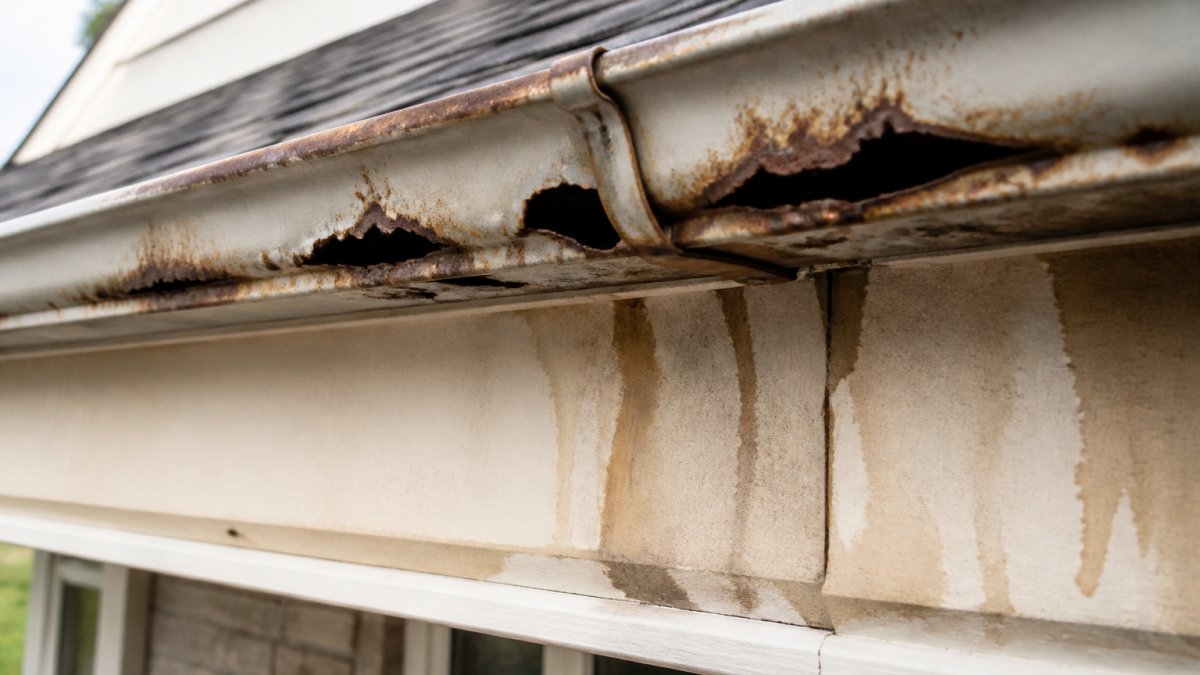
Metal gutters rust when protective coatings wear away, showing orange, brown, or dark discoloration. Corrosion eats through the material, creating leaking pinholes.
Pinholes are tiny but dangerous:
- They start small and grow
- Multiple pinholes mean the gutter is nearing failure
- Corrosion spreads faster once it starts
If rust spreads across more than 10% of your gutter, replacement usually beats repair; patching one area doesn’t stop corrosion elsewhere.
Peeling Paint and Water Damage Near Fascia and Soffits
Peeling paint on fascia or soffit signals water damage: gutters leak down your home’s sides, saturating wood and causing paint to peel.
Water damage shows as:
- Soft, spongy wood when you press on the fascia
- Discoloration or dark stains
- Gaps opening between gutters and roofline
Damaged fascia and soffits need replacement too, and timing that work with gutter replacement saves money.
Damage to Landscaping and Soil Erosion
Overflowing or leaking gutters dump concentrated water that erodes soil, damages plantings, and carves gullies in your yard.
Signs of water damage in landscaping:
- Bare patches where plants won’t grow
- Soil washing away from foundation areas
- Gullies or channels in your yard after rain
Erosion near your foundation is serious; exposed soil lets water seep into basements or crawlspaces. Fixing gutters stops it before it gets expensive.
How Long Do Gutters Last
Gutter lifespan is a range, not a fixed number. Two homes on the same street with the same material can differ by 10 years based on installation, maintenance, and climate, turning a generic “15 to 20 years” into a useful planning tool.
Lifespan by Material
| Material | Typical service life | Key failure mode | Relative cost |
|---|---|---|---|
| Vinyl | 10-15 years | Brittleness and cracking from freeze-thaw and UV exposure | Lowest |
| Aluminum | 15-20 years | Seam separation, fastener pull-out, occasional pinhole corrosion | Moderate |
| Galvanized steel | 12-15 years | Rust-through once the zinc coating is compromised | Low to moderate |
| Copper | 40-50 years | Patina is cosmetic; failure usually comes from poor installation or fastener corrosion | High |
| Zinc | 30-40 years | Slow surface oxidation; joint and hanger failure before material failure | High |
These ranges assume proper installation and routine cleaning. Skip either and the low end becomes optimistic.
What Actually Shortens Lifespan
Material is only the starting point. The bigger variables:
- Pitch and drainage. Gutters must slope toward the downspouts, commonly about 1/16 inch per foot of run. Flat or back-pitched runs hold standing water, which accelerates corrosion on metal and stress-cracking on vinyl.
- Fastener spacing and type. Hangers spaced too far apart let the gutter sag under the weight of water and debris. Hidden hangers screwed into solid fascia outperform spike-and-ferrule setups, which loosen as the wood dries and shrinks.
- Seam quality. Every seam is a potential leak point. Seamless runs formed on site eliminate most of them; sectional gutters rely on sealant that degrades over time.
Reading the Range for Your Home
A 12-year-old gutter cleaned twice a year, correctly pitched, with minor oxidation will likely reach the high end of its range. A 12-year-old gutter that’s been ignored, sags in two places, and shows rust spreading from the seams is already past its practical life.
Use the material range as a planning horizon, then adjust based on inspection. Age alone rarely justifies replacement; age plus widespread damage does.
If your gutters are more than two-thirds of the way through their expected lifespan and you are already planning a roof or fascia project, replacing them at the same time usually costs less than coming back to them separately.
Installation Quality Is the Hidden Variable
A copper gutter with poor pitch and too few hangers will fail before a correctly installed vinyl gutter. The details that matter most:
- Correct slope toward downspouts on every run
- Hangers spaced close enough to prevent sagging under full water load
- Downspouts sized and positioned to handle the roof area draining to them
When getting quotes, ask how the contractor handles pitch, hanger spacing, and seam treatment; the answers reveal more about lifespan than the material sample book.
Gutter Inspection Checklist
Regular inspection catches problems early. Do a basic visual check twice a year; a professional inspection catches what you might miss.
What to Look For During Inspection
Start from the ground and work up. Use binoculars to see details without climbing.
Check these points:
- Visible cracks, holes, or rust spots
- Gutters sagging or pulling away from the roofline
- Loose or missing fasteners
Photograph any damage to track changes and give contractors clear information.
When to Call a Professional
Some inspection tasks are better left to professionals. Climbing a ladder on a two-story home is risky; a professional can inspect the entire system safely.
Call a professional if you notice:
- Multiple problem areas
- Damage you can’t assess from the ground
- Uncertainty about whether repair or replacement is needed
HighLow Roofing & Exteriors offers free estimates to assess your gutter condition. A professional spots early-stage corrosion, hidden cracks, and structural issues that affect your decision.
Gutter Repair Versus Replacement: Making the Right Choice
Most homeowners facing gutter damage want a straight answer: fix it or replace it? It depends on where the damage is, how much there is, and how old the system is. A decision framework removes the guesswork.
Step 1: Count and Locate the Defects
Location matters as much as quantity. A single cracked seam on an otherwise sound run is a repair. The same crack on every seam along a run signals the material or installation is failing.
- One or two isolated defects on a run that is otherwise straight, well-fastened, and free of corrosion, repair is usually reasonable.
- Defects clustered in one section (for example, the run under a valley that takes heavy water flow), repair that section, but watch it closely.
- Defects spread across multiple runs, the system is telling you it is at the end of its service life.
Step 2: Check the Age Against the Material Range
A 6-year-old aluminum gutter with a cracked seam is worth repairing; a 19-year-old one with the same crack is near the end of its range and will likely develop more problems soon.
As a rule of thumb, if the gutter is past roughly two-thirds of its expected service life with more than one defect, replacement is the more durable choice; repairing a system near failure just delays the inevitable.
Step 3: Inspect the Fascia and Soffit
Gutters attach to the fascia board. If the fascia is soft, stained, or rotting, the attachment points are compromised no matter how good the gutter looks. In that case:
- The gutter has to come off to replace the fascia.
- Reinstalling the old gutter after fascia work rarely makes sense; you are paying the labor twice.
- New gutters installed on new fascia with fresh fasteners will perform better and last longer.
If the fascia and soffit are solid, repair becomes a more viable option.
Step 4: Compare Repair Scope to Replacement Scope
A useful threshold: if the repair touches more than about a quarter of the total gutter run or requires re-sealing multiple seams, replacement is usually the better value; you’re paying most of the labor without getting new material.
Repair is the better choice when:
- Damage is limited to one or two isolated spots
- The gutter is well within its expected lifespan
- Fascia and soffit are solid
Replacement is the better choice when:
- Multiple runs show damage
- Rust or corrosion is spreading beyond isolated spots
- Gutters sag or pull away from the roofline in more than one place
Why Failing Gutters Cost More Than Replacement
Water follows the path of least resistance. When a gutter fails, that path runs down your fascia, behind your siding, and toward your foundation.
- Fascia and soffit. Water wicks into the wood, causing rot that spreads to rafters and roof decking. Rot repair is significantly more involved than gutter replacement.
- Siding. Water staining and moisture behind siding leads to paint failure, rot, and in some cases mold.
- Foundation. Water pooling at the base of the home increases hydrostatic pressure against foundation walls. That can lead to cracks, seepage, and basement moisture.
Each pathway costs more to fix than replacing the gutters that caused it; the core argument for acting on widespread damage rather than patching.
If you can count the defects on one hand and the fascia is solid, repair. If the defects are widespread, the system is old, or the fascia is compromised, replacement is the more economical decision once you factor in the water damage a failing system can cause.
Getting a Clear Answer
A professional assessment is worth it when you’re uncertain, damage is hard to see from the ground, or fascia and soffit condition is unclear. An inspector checks pitch, fastener security, and hidden corrosion, then gives a straight repair-or-replace recommendation.
Planning Your Gutter Replacement
Timing your gutter replacement strategically saves money and reduces disruption.
Timing and Coordination with Other Work
Replace gutters before major rain seasons. Spring and fall are ideal.
Coordinate gutter replacement with other exterior work:
- Schedule together with roof replacement to avoid multiple contractor visits
- Plan with fascia and soffit repairs to use one crew
- Time work before siding replacement if needed
Bundling exterior work reduces labor costs. One crew handles multiple jobs.
Spring is often best; winter damage is visible, and you can plan repairs before summer storms.
Failing gutters put your home at risk.
HighLow Roofing & Exteriors specializes in gutter replacement and exterior protection.
Frequently Asked Questions
What are the most common signs that gutters need to be replaced?
The clearest indicators are visible cracks or holes, rust and corrosion spots, sagging sections, water leaks during rainfall, and peeling paint on fascia or soffits. If your gutters are pulling away from the roofline or you notice standing water inside them, replacement is likely needed soon. Inspect your gutters twice yearly, especially after storms, to catch these problems early.
How long do gutters typically last before replacement?
Gutter lifespan depends on material and local conditions. Metal gutters generally last 20-40 years, while vinyl options typically last 15-25 years. In regions with heavy rainfall, freeze-thaw cycles, or significant debris accumulation, gutters may need replacement sooner. Regular maintenance and cleaning extend the life of your gutter system significantly.
Should I repair my gutters or replace them entirely?
Replace gutters if they’re over 20 years old, have multiple damaged sections, or show widespread rust and corrosion. Repair individual sections if damage is isolated to one area and the rest of the system is sound. Consider replacement timing with roof work or fascia updates to reduce overall labor costs.
Can I replace just one section of my gutters, or do all gutters need replacing?
You can replace individual sections if damage is localized and the rest of the gutter system is functioning well. However, if your gutters are aging uniformly or show widespread wear, replacing the entire system ensures consistent water drainage and prevents future patchwork repairs. Discuss options with a professional contractor to determine the most cost-effective approach for your situation.