
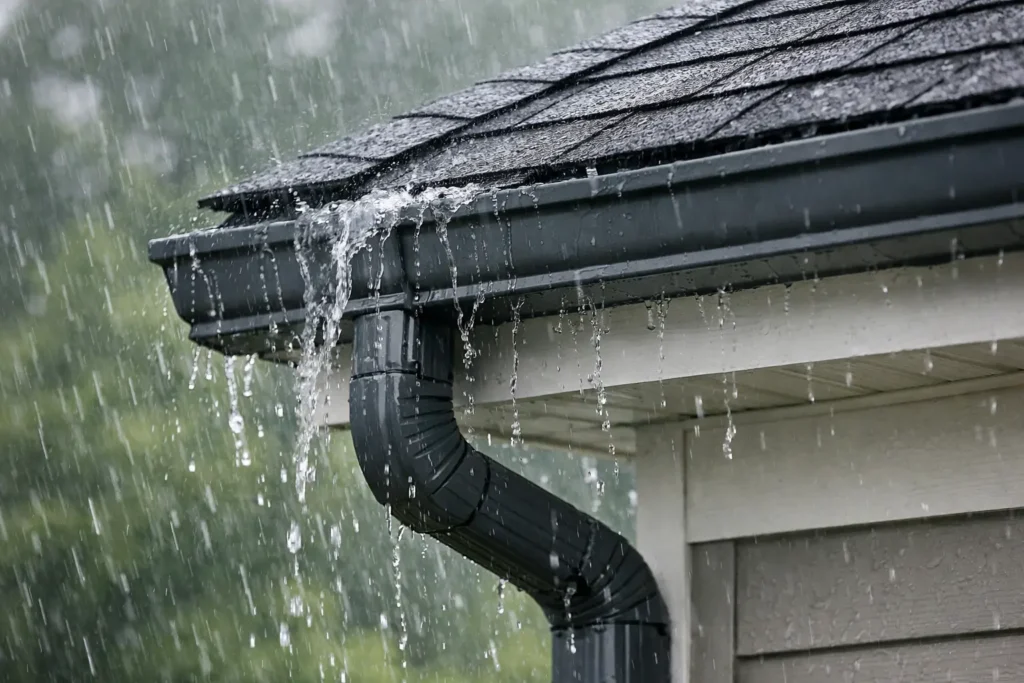
A hard rain should move safely away from your home, not pour over the gutter edge, soak the siding, and collect beside the foundation. The best gutters for heavy rain are not simply the widest gutters available. They are a properly sized, securely installed system with enough downspout capacity to handle the water coming off your particular roof.
For homeowners in Lethbridge and Southern Alberta, that distinction matters. Sudden summer storms, wind-driven rain, spring runoff, and winter freeze-thaw cycles can all expose weak points in an aging gutter system. A quality installation protects more than the roofline. It helps preserve fascia, siding, landscaping, walkways, and the foundation below.
What Makes Gutters Work in Heavy Rain?
Gutters have one job: collect roof runoff and direct it away from the house. When rainfall is heavy, every part of the system has to do its share. The gutter needs enough volume to catch water without overflowing. The slope must carry that water toward the outlets. Downspouts must move it to a safe discharge point before the gutter backs up.
A gutter can be made from excellent material and still fail during a storm if it is undersized or has too few downspouts. On the other hand, a larger gutter will not solve a problem caused by poor pitch, loose hangers, or a downspout that empties directly beside the foundation.
Roof shape also changes the calculation. A simple, low-slope roof sheds water differently than a large, steep roof with long valleys. Valleys concentrate runoff into a small area, which is why homeowners often notice overflow at those locations first. A professional assessment should consider the roof’s square footage, pitch, drainage layout, and the areas where water naturally converges.
Best Gutter Sizes for Heavy Rain
For many homes, 5-inch K-style gutters are a standard starting point. They can work well on modest roof sections with straightforward drainage. But when a home has a large roof surface, steep slopes, or active valleys, 6-inch gutters are often the smarter long-term choice.
A 6-inch gutter carries noticeably more water than a 5-inch profile. That extra capacity can make the difference between controlled drainage and water spilling over the front edge during a downpour. The visual difference is usually subtle, especially when the gutter color is matched to the fascia or siding, but the performance difference can be significant.
Half-round gutters are another option, often chosen for their classic appearance. They can perform well when sized and installed correctly, but their shape generally provides less carrying capacity than a K-style gutter of comparable width. For a home where heavy-rain performance is the priority, a 6-inch K-style system is commonly the practical choice.
Downspouts Matter as Much as Gutter Size
A large gutter feeding into undersized downspouts creates a bottleneck. Water reaches the outlet but cannot exit fast enough, then rises and spills over. For heavy-rain conditions, larger downspouts and adequate outlet placement are essential.
Rectangular 3-by-4-inch downspouts move substantially more water than smaller 2-by-3-inch versions. The best layout depends on the roof and gutter run, but long runs and high-flow areas may need additional downspouts rather than relying on one outlet at the end. This is particularly true beneath roof valleys and on sections that receive runoff from more than one roof plane.
Downspout extensions should carry water well away from the foundation. If discharge lands next to the home, even a perfectly functioning gutter system can contribute to saturated soil, settling, and moisture problems below grade.
Which Gutter Material Holds Up Best?
Material affects cost, appearance, maintenance, and service life. No single material is right for every property, but aluminum is often the best balance for residential heavy-rain performance.
Seamless Aluminum Gutters
Seamless aluminum gutters are a dependable choice for most homes. They are lightweight, corrosion-resistant, available in many colors, and formed on-site to fit each roofline. Because they have fewer joints along the main run, they have fewer places where leaks can develop over time.
Aluminum is not indestructible. It can dent if struck by a ladder or heavy debris, and thin material is more prone to damage. Choosing a quality gauge and having the gutters professionally fastened helps the system hold its shape through wind, snow, and repeated water loads.
Steel, Copper, and Vinyl Gutters
Galvanized steel offers strength but requires attention to prevent rust, especially where coatings become scratched or worn. It can be a good fit in specific applications, though it is heavier and generally requires more maintenance than aluminum.
Copper is long-lasting and distinctive, but it is a premium material with a premium price. It is typically selected for architectural character rather than as the most cost-effective answer to heavy rainfall.
Vinyl gutters are inexpensive and easy to find, but they are usually not the best choice for harsh climates or high-volume drainage. Temperature swings can make vinyl brittle, seams can become a concern, and long sections may sag under standing water. For homeowners looking for lasting protection, professionally installed metal gutters are usually the better investment.
Installation Details That Prevent Overflow
The best gutters for heavy rain need careful installation, not just good components. Gutters should be set with a consistent, subtle slope toward the downspouts. Too little pitch can leave standing water and debris. Too much can look uneven and may cause water to rush past outlets on a long run.
Hanger spacing is also critical. Strong, properly placed hidden hangers help keep the gutter attached to the fascia when it is carrying water or supporting snow and ice. Loose gutters pull away from the roofline, creating gaps where runoff can fall behind the system and damage the wood beneath.
The fascia behind the gutter should be inspected before replacement. Soft, rotted, or poorly secured fascia will not hold fasteners reliably. Replacing damaged fascia before the new gutters go up is a far better solution than fastening a new system to compromised wood and hoping it holds.
At valleys, an installer may recommend a wider gutter, an additional downspout, or a diverter to control concentrated flow. These are not unnecessary extras when water repeatedly overshoots the gutter in the same spot. They are targeted solutions to the way your roof sheds water.
Are Gutter Guards Worth It for Heavy Rain?
Gutter guards can help, but they are not a substitute for correct sizing and installation. Their main purpose is to reduce debris buildup, allowing water to reach the gutter and downspouts more consistently. A clogged gutter has far less capacity during a storm, even if it was correctly sized on day one.
The right guard depends on the debris around the home. Fine mesh guards can block small leaves and roofing grit, while other designs are better suited to larger leaves and needles. Some guards may shed water poorly when installed incorrectly or when matched with a steep roof, so product selection matters.
Even with guards, occasional inspection is wise. Check that water is entering the gutter rather than running over the guard, and make sure downspouts remain clear. Maintenance needs may be lower, but they are rarely eliminated completely.
Signs Your Current Gutters Cannot Handle Rain
Overflow during a major storm is the clearest warning, but it is not the only one. Look for water stains on soffit or fascia, peeling paint, soil erosion, mildew near the foundation, or splash marks on siding. Gutters that sag, pull away from the house, or hold standing water also need attention.
Do not assume every overflow problem requires a full replacement. A blockage, loose hanger, missing extension, or inadequate downspout can sometimes be corrected with a focused repair. However, if the gutters are old, heavily dented, leaking at multiple seams, or consistently undersized for the roof, replacement may offer better value than repeated patchwork.
A local exterior contractor can assess the full water-management picture, including the roof edge, soffit, fascia, gutter capacity, and discharge locations. At HighLow Roofing & Exteriors, that practical, whole-home approach helps homeowners make decisions based on the condition of their property rather than a one-size-fits-all recommendation.
When the next hard rain arrives, your gutter system should be the quiet part of the home. A properly designed system lets water move where it belongs, so you can focus on the weather outside instead of wondering what it is doing to your foundation.