
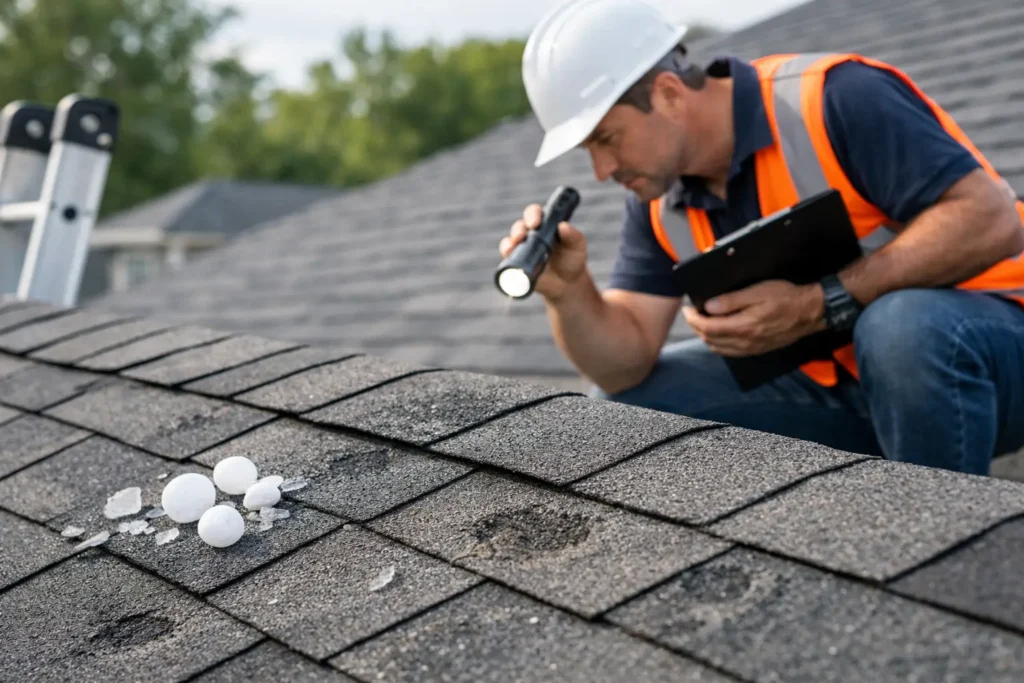
Last night’s storm can be over in twenty minutes, but the damage it leaves behind can stay hidden for months. That is why homeowners who know the top signs of roof hail damage are in a much better position to protect their homes before a small issue turns into a costly repair.
In Southern Alberta, hail is not a rare event or a minor inconvenience. It can shorten the life of shingles, damage flashing, loosen granules, and create weak points that let water in later. The tricky part is that hail damage does not always look dramatic from the ground. A roof can appear mostly fine while still carrying impact damage that needs attention.
Why hail damage is easy to miss
Most homeowners expect hail damage to look like a hole punched through the roof. Sometimes that happens, but more often the signs are subtle. Asphalt shingles may show bruising where the surface mat has been weakened. Metal components may have dents that seem cosmetic but still affect drainage or performance. Gutters and downspouts may take visible hits even when the roof damage is harder to spot.
That is also why timing matters. The sooner a roof is inspected after a hailstorm, the easier it is to separate fresh storm damage from older wear and tear. Waiting too long can blur the picture and allow water intrusion to spread into decking, insulation, soffit, or fascia.
Top signs of roof hail damage on the outside
The most common visible clue is bruised or pitted shingles. On an asphalt roof, hail can knock off protective granules and leave dark, soft spots. If a shingle looks patchy or has random circular marks, that is worth a closer look. These impacts weaken the protective surface, even if the shingle is not leaking yet.
Another sign is a heavy buildup of granules in the gutters or at the bottom of downspouts. Shingles naturally lose some granules over time, especially on older roofs, so this is not always a red flag by itself. But if a storm just passed through and you suddenly notice a large amount of gritty material collecting around drainage areas, hail may be the reason.
Dented metal is another strong indicator. Check roof vents, flashing, chimney caps, gutter systems, and other exposed metal surfaces. If hail was strong enough to leave fresh dents on soft metals, there is a good chance the shingles took a hit too. This does not automatically mean full replacement is needed, but it does justify a professional inspection.
You may also notice cracked, split, or lifted shingles. Larger hailstones can fracture the shingle surface or break the edges, especially on older roofs that have already become more brittle over time. In some cases, the damage is not a clean crack. Instead, the shingle may look slightly distorted or uneven where the impact weakened its structure.
Top signs of roof hail damage inside the home
A roof problem does not always announce itself with a ceiling drip right away. Sometimes the first signs show up in the attic or upper rooms. Water stains on ceilings, damp insulation, peeling paint near rooflines, or a musty smell after a storm can all point to damage overhead.
If you have attic access, look for daylight coming through where it should not, damp wood, or dark staining around the underside of the roof deck. Not every hail-damaged roof leaks immediately, but a compromised roof system becomes more vulnerable with each wind-driven rain that follows.
It is also smart to pay attention to changes around vents, skylights, and wall intersections. Hail can damage the surrounding flashing or loosen key transition points. Those areas often fail before the main field of shingles does.
What hail damage looks like on different roofing materials
Not every roof reacts to hail the same way. Asphalt shingles typically show granule loss, bruising, or cracking. That makes them one of the more straightforward materials to inspect, but only if someone knows what to look for.
Metal roofing can hold up very well in hail-prone regions, but it is not immune. The question often becomes whether the damage is cosmetic or functional. A few dents may not affect performance, but impact around seams, fasteners, or flashing can create longer-term problems.
Older roofs are generally at greater risk regardless of material. A roof near the end of its service life has less flexibility and less margin for impact. Newer materials may resist damage better, but hail size, wind speed, and storm direction all matter. That is why two homes on the same street can come away with very different results.
What not to do after a hailstorm
One common mistake is climbing onto the roof for a close inspection without the right safety equipment or experience. Hail damage can be hard to recognize, and storm-affected surfaces can be slick or unstable. A ground-level check is reasonable for obvious issues, but walking the roof is often where homeowners put themselves at unnecessary risk.
Another mistake is assuming no visible leak means no problem. Hail damage often weakens roofing materials first and shows consequences later. By the time interior damage appears, the repair can be larger and more expensive.
It is also worth avoiding quick conclusions based only on one sign. For example, dented gutters alone do not prove major roof damage, and granule loss alone does not always mean hail. Good assessment comes from looking at the full pattern across shingles, accessories, drainage, and interior areas.
When to call for a professional inspection
If your neighborhood had a hailstorm with enough force to damage vehicles, siding, screens, or outdoor furniture, your roof deserves attention too. The same goes if you see dark spots on shingles, fresh granules in gutters, dented vents, or any sign of moisture inside.
A professional inspection helps answer the questions that matter most. Is the damage cosmetic or functional? Is repair enough, or has the storm shortened the roof’s lifespan enough to justify replacement? Are other exterior systems affected too, including gutters, soffit, fascia, or siding?
For homeowners in Lethbridge and nearby communities, local experience matters. Storm patterns, temperature swings, and wind exposure all shape how roofs wear in this region. A contractor who works in Southern Alberta understands the difference between normal aging and storm-related impact, which leads to clearer recommendations and fewer surprises.
Why early action protects more than your shingles
A damaged roof does not only threaten the shingles themselves. Once water finds a path in, it can affect roof decking, insulation, interior drywall, trim, and even the performance of your ventilation system. That is where a quick inspection becomes a smart investment instead of an unnecessary expense.
Early action also gives you more options. Minor localized damage may be repairable if caught soon enough. If the damage is more extensive, documenting it early can make the next steps much more straightforward. Either way, the goal is the same: protect the home, preserve its value, and avoid letting a storm from one season create a much bigger problem in the next.
A practical way to check after the next storm
Start from the ground. Walk around your home and look for dents on gutters, downspouts, metal flashing, and window trim. Check for shingle pieces or unusual granule buildup near downspout exits. Then look inside the attic and top-floor ceilings for moisture marks, damp insulation, or new staining.
If anything looks off, or if the storm was severe enough that you are simply not sure, have the roof inspected by a qualified local contractor. At HighLow Roofing & Exteriors, that kind of straightforward, honest guidance is what homeowners count on when weather puts their home to the test.
Hail does not always leave obvious damage, but it often leaves enough warning signs to act before real trouble starts. The best next step is not guessing from the driveway. It is getting a clear look at the condition of your roof while the problem is still manageable.