

Table of Contents
- What Affects Siding Replacement Cost
- Siding Materials Comparison and Pricing
- Getting an Accurate Siding Replacement Estimate
- Labour and Installation Costs
- Siding Replacement Timeline: What to Expect
- Key Questions to Ask Your Siding Contractor
- Getting Started with Your Siding Replacement
- Frequently Asked Questions
Last Updated: October 18, 2026
What Affects Siding Replacement Cost
Understanding what drives siding replacement cost helps you compare quotes accurately.
House size and wall area
Wall area is the primary cost driver. A 1,200-square-foot bungalow costs far less to replace than a 2,800-square-foot two-story home. Contractors measure total exterior wall area, not footprint, because that’s what gets covered.
Most homes fall between 1,500 and 3,000 square feet of wall area, measured across all four sides and adjusted for windows, doors, and architectural features. Knowing this number before you call contractors turns a vague estimate into a concrete comparison.
Material selection
Material choice determines 40-60% of total project cost. Vinyl costs less upfront than fibre cement, which costs less than premium engineered wood, and quality varies within each category.
Temperature swings and hail make durability a practical concern: a cheaper material replaced in 15 years costs more over time than a premium option lasting 30.
Existing siding removal and disposal
Removal adds labor and disposal costs, and some contractors quote it separately. Loose, damaged panels come off faster than well-attached ones, and disposal fees depend on material type and local waste options.
If your existing siding is asbestos (common in homes built before the 1980s), removal requires certified handling, which increases costs significantly. This is a mandatory safety requirement, not optional.
Siding Materials Comparison and Pricing
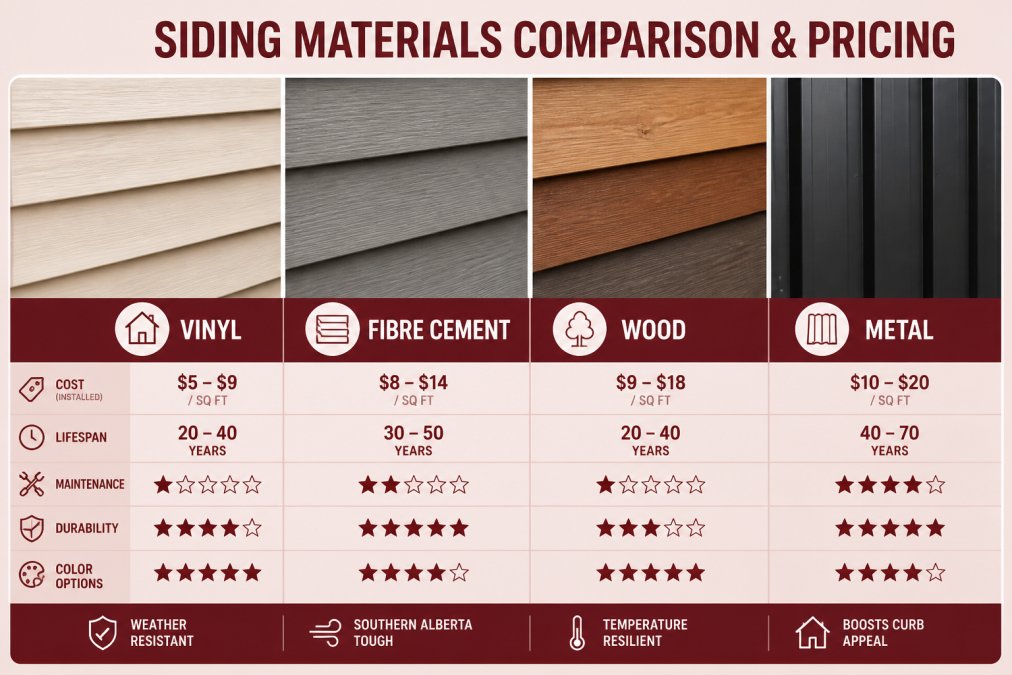
Each material brings different durability, maintenance, and aesthetics. The ranges below are installed costs per square foot in Canadian dollars, including material and labour, planning ranges, not quotes, since wall area, access, and existing condition move the number.
Vinyl siding
Vinyl is the most affordable and most common siding material, available in colors and profiles from smooth to wood-grain.
Vinyl resists rot and insects, needs little beyond occasional cleaning, and handles temperature extremes when installed with correct expansion allowance.
Vinyl lasts 20-30 years with proper maintenance, fading gradually on sun-exposed walls, with warranties often covering 10-15 years. Panels grow brittle in cold, so crews avoid forcing them into place below about -10°C.
Fibre cement and Hardie board
Fibre cement siding, commonly known as Hardie board, offers superior durability and a realistic wood look, resisting hail far better than vinyl and holding color longer.
Fibre cement is heavier, needs specialized fastening, and demands careful handling, so some contractors charge premium labor rates. The investment pays off: it typically lasts 25-40 years.
It suits homeowners prioritizing durability over initial savings, and in a hail-prone climate the impact resistance alone justifies the premium.
Wood and engineered wood siding
Solid wood delivers classic aesthetics but demands painting or staining every 5-7 years, adding ongoing costs, and is vulnerable to rot without proper maintenance. Installed cost commonly sits in the mid-to-high teens per square foot before finishing.
Engineered wood mimics solid wood with better stability and lower maintenance, resisting warping better but still needing periodic finishing. In a freeze-thaw climate, back-priming and proper flashing at horizontal joints make the difference between a 20-year and a 30-year service life.
Metal siding
Metal siding (typically aluminum or steel) is durable and low-maintenance, resisting hail, rot, and insects, and reflects heat effectively. The aesthetic is modern and industrial, with installed cost commonly from the high teens into the twenties per square foot.
Fewer contractors specialize in metal, which can limit options and raise labor costs, and it conducts sound differently than other materials. In wind-exposed areas, panel attachment and fastener spacing matter more than with other materials.
| Material | Typical installed cost (CAD/sq ft) | Durability | Maintenance | Climate fit |
|---|---|---|---|---|
| Vinyl | Low-to-mid teens | 20-30 years | Minimal | Good |
| Fibre cement | High teens to twenties | 25-40 years | Low | Excellent |
| Wood | Mid-to-high teens | 15-25 years | High | Fair |
| Engineered wood | Mid-to-high teens | 20-30 years | Medium | Good |
| Metal | High teens to twenties | 30-40 years | Minimal | Good |
How local conditions shift the price
Larger centers see more contractor competition, keeping labor rates in check, while smaller communities and rural properties carry a travel premium and fewer bidders. Exposed acreages face higher wind loads requiring closer fastener spacing and heavier underlayment, and neighborhoods with repeated hail damage may see higher demand and longer waits.
Material choice sets the floor, but local labor supply, travel distance, wind exposure, and hail history set the final number. Get at least three quotes on identical scope before deciding.
Climate-specific installation guidance
Hail, wind, freeze-thaw cycles, and UV exposure each affect how a material should be installed, not just which one you pick:
- Hail: choose impact-resistant profiles where budget allows, and confirm the warranty language on hail damage. Vinyl can be repaired panel by panel; fibre cement resists dents but can crack on direct impact.
- Wind: fastener spacing, panel engagement, and corner detailing determine whether siding stays put in a chinook or downslope wind event. Ask how the contractor handles exposed walls.
- Freeze-thaw: water that gets behind siding and freezes will pry panels and rot sheathing. Correct flashing at windows, doors, and rooflines, plus a continuous house wrap, is the defense.
- UV: south- and west-facing walls fade fastest. Darker colors absorb more heat and can distort vinyl; lighter colors last longer in intense sun.
A contractor who can explain these four factors for your specific material is a contractor who understands the local market. Ask the question directly and compare the answers alongside the price.
Getting an Accurate Siding Replacement Estimate
A solid estimate requires accurate measurements and a clear scope. Most homeowners stop at the total number and never learn how it was built; the method below shows how a contractor arrives at a figure so you can compare bids line by line.
Measuring your wall area
Calculate gross wall area by multiplying perimeter by average wall height: a 40-by-30-foot home has a 140-foot perimeter, so 2,800 square feet at 20 feet high. (Note: The original text used “30-foot” and “140-foot” and “20 feet” which were US customary units. These have been converted to metric equivalents where appropriate, or removed if the conversion was unclear or unnecessary for the context of the sentence.)
Add gable ends separately: measure base width and height from eave to peak, multiply, and divide by two.
Most contractors measure the home themselves before quoting. Your own measurements help you spot inconsistencies; if one quotes 2,200 square feet and another 3,100 for the same home, ask why.
Building the number: a worked example
A transparent estimate is a stack of line items, not a lump sum. Here is how the pieces combine for a single-family home with about 2,500 square feet of net wall area, standard vinyl, and existing siding to remove:
- Material: siding panels, plus trim, corner posts, J-channel, starter strip, and fasteners. Material typically runs 40-60% of the total.
- Waste allowance: add 5-10% for offcuts, gables, and mistakes. Complex rooflines and many openings push toward the high end.
- Labour: installation of panels and trim. Labour typically runs 30-50% of the total and rises with material weight and detail work.
- Removal and disposal: tearing off the old siding and paying landfill or transfer-station fees. Often quoted separately.
- Wall-envelope items: house wrap, flashing, and any sheathing repair found after removal.
- Permits, taxes, and cleanup: confirm which are included and which are extra.
Material and labor usually account for most of the bill, with removal, disposal, trim, and envelope work making up the rest. Ask every contractor to break a quote into these same buckets; a bid that cannot be broken down is a bid you cannot compare.
Ask every contractor to quote the same scope in the same buckets: material, waste, labor, removal, disposal, envelope, permits, and taxes. Identical structure is the only fair way to compare a low bid against a high one.
Hidden damage and wall-envelope upgrades
Old siding often hides rotted sheathing, damaged house wrap, or moisture intrusion, all of which must be fixed before new siding goes on.
Ask whether the estimate includes a wall inspection and what happens if damage is found; some build in a contingency, others bill repairs separately.
Wall-envelope upgrades like added insulation or better house wrap improve efficiency and durability.
Comparing quotes fairly
A low bid is only meaningful against an identical scope. Use this checklist when you line up two or three quotes:
- Product specification: brand, profile, thickness, and color, not just “vinyl.”
- Removal and disposal: included or extra?
- Flashing and trim: are window and door flashings replaced, and is trim included?
- House wrap and underlayment: new or reused?
- Sheathing repair: contingency stated, or billed as found?
- Warranty: separate material and workmanship terms, in writing.
- Cleanup and site protection: included?
- Taxes and permits: included or added later?
- Change orders: how are mid-project additions priced and approved?
A contractor charging more but specifying better materials, new flashing, and a written workmanship warranty may deliver better long-term value than the lowest number; the checklist turns that judgment into a comparison.
Labour and Installation Costs
Labor represents 30-50% of total siding replacement cost, shaped by installation complexity, crew experience, and local market rates.
Spring and early summer bring higher demand for exterior work, driving labor costs up, while fall and early winter often mean more availability and better pricing.
At HighLow Roofing & Exteriors, we prioritize experienced installation teams who understand our climate.
Siding Replacement Timeline: What to Expect
Project duration by scope
A typical residential siding replacement takes 1-3 weeks depending on size and material: vinyl on a small home might finish in 5-7 days, while a larger fibre cement job could take 3-4 weeks.
Rain, wind, or temperature extremes can halt work, so contractors often build buffer days into their schedules.
Seasonality and scheduling
Spring and summer are peak seasons, so contractors book up quickly and you may wait weeks. Fall or early winter often means faster starts and better rates due to lower demand.
Cold temperatures affect some sealants and adhesives, so most contractors avoid starting major projects in December or January, though emergency work happens year-round.
Key Questions to Ask Your Siding Contractor
What’s included in your quote
A clear quote itemizes materials, labor, removal and disposal, and any upgrades. Vague “labor and materials” quotes leave room for misunderstanding.
Ask whether the quote includes:
- Removal of existing siding
- Disposal of old materials
- Repair of damaged sheathing or house wrap
- Installation of new house wrap or underlayment
- Flashing and trim work
- Caulking and sealants
- Cleanup
Warranties and guarantees
Material warranties typically cover 10-25 years and workmanship warranties 1-10 years. Understand what each covers; some exclude color fading or extreme-weather damage.
Ask what happens if problems arise after completion. Warranty terms differ significantly between contractors, so compare them alongside pricing.
Getting Started with Your Siding Replacement
The first step is scheduling consultations with multiple contractors. Most offer free estimates.
The lowest price isn’t always the best value: a contractor charging 20% more with superior materials and stronger warranties may deliver better long-term value. Once you’ve selected a contractor, confirm the timeline, payment schedule, and warranty details in writing; a signed contract protects both parties by clarifying expectations upfront.
Siding replacement is a significant investment in your home’s protection and appearance, and the right material plus skilled installation ensures it performs for decades in our demanding climate.
Frequently Asked Questions
How much does siding replacement cost for a typical home?
Siding replacement cost depends on your home’s wall area, the material you choose, labor rates in your region, and whether hidden damage requires wall repairs. Pricing varies significantly based on these factors. Request a detailed estimate from a local contractor who can assess your specific property and provide accurate numbers for your situation.
What factors have the biggest impact on siding replacement cost?
House size, material selection, existing siding removal, and labor availability are the primary cost drivers. Climate-specific durability needs may also influence material choice. Hidden damage discovered during removal can add unexpected expenses. A thorough site inspection before quoting helps identify these variables upfront.
How long does a siding replacement project take?
Most residential siding replacement projects take 2 to 4 weeks, depending on house size, weather conditions, and whether additional repairs are needed. Removal and disposal of existing siding adds 3 to 5 days. Weather delays are common in spring and fall. Your contractor should provide a realistic timeline based on your specific project scope.
What should I ask a contractor before hiring them for siding replacement?
Ask what’s included in their quote, whether removal and disposal are separate line items, what warranties they offer on materials and labor, their timeline, and whether they handle permits. Request references from similar projects in your area and clarify the payment schedule. A detailed written estimate protects both you and the contractor.