
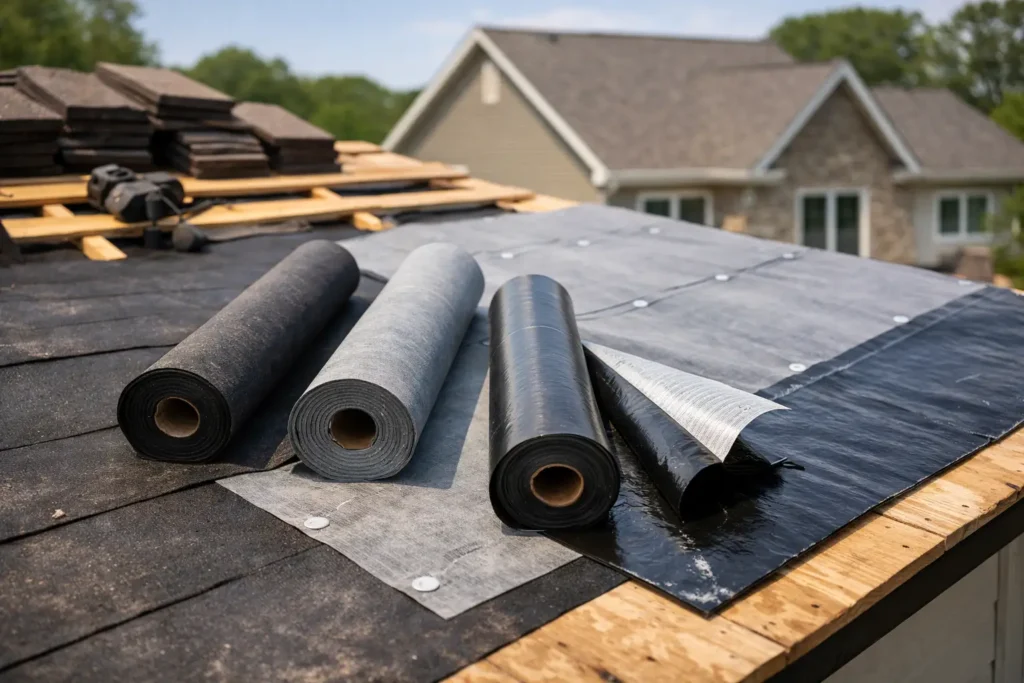
A new roof can look perfect from the street and still be vulnerable beneath the shingles. The layer between your roof deck and the finished roofing material does much of the quiet work: managing wind-driven rain, backing up the primary roof covering, and helping protect the wood structure when weather turns severe. Choosing among the best roofing underlayment types is especially important for homes exposed to snow, freeze-thaw cycles, strong winds, and sudden storms.
Underlayment is not the part of a roof most homeowners see, but it directly affects how well the system performs over time. The right choice depends on your roof material, slope, ventilation, local climate, budget, and the condition of the deck underneath. A dependable contractor should explain those trade-offs clearly rather than treating every roof the same.
What Roofing Underlayment Does
Roofing underlayment is a protective sheet installed directly over the roof deck before shingles, metal panels, or another finished material goes on. Its primary role is to create a secondary barrier against moisture. If rain gets beneath shingles during high winds, or snow and ice force water where it does not belong, the underlayment helps prevent that moisture from reaching the decking and attic.
It also gives installers a safer, more stable working surface during replacement. More importantly, quality underlayment can reduce the risk of deck rot, mold, insulation damage, and interior leaks caused by minor failures in the outer roofing layer.
Underlayment is only one part of a complete roofing system. Flashing around chimneys, walls, vents, skylights, valleys, and roof edges matters just as much. Good materials cannot compensate for poor installation, skipped details, or damaged roof decking.
Best Roofing Underlayment Types Compared
The four most common underlayment categories are asphalt-saturated felt, synthetic underlayment, self-adhered membrane, and high-temperature underlayment for metal roofing. Each has a place, but none is automatically the right fit for every home.
Asphalt-Saturated Felt
Asphalt-saturated felt, often called roofing felt or tar paper, has been used for generations. It is typically available in lighter and heavier weights, and it remains a familiar option for asphalt shingle roofs.
Its biggest advantage is cost. Felt is generally less expensive than synthetic products and can provide reliable water resistance when installed correctly and covered promptly. For a straightforward roof replacement with a limited budget, it may be a reasonable choice.
The trade-off is durability during installation. Felt can wrinkle, tear, or absorb moisture if left exposed for too long. It is also heavier and less stable under foot than many modern alternatives. In areas that see changing weather during a roofing project, those limitations can matter.
Synthetic Underlayment
Synthetic underlayment has become a popular choice for many residential roof replacements. Made from engineered polymers, it is lighter than felt, easier to handle, and usually more resistant to tearing, wrinkling, and water exposure.
For many homeowners, synthetic underlayment offers the best balance of performance and value. It lays flatter across the roof deck, often provides better traction for installers, and can tolerate short periods of weather exposure if a project is interrupted. That extra durability is useful in regions where wind and unpredictable conditions are part of the job.
Not all synthetic products perform the same way. Some are designed for standard asphalt shingle applications, while others are rated for specific roof coverings or higher-temperature conditions. The product must also be installed according to the roofing manufacturer’s specifications. Otherwise, it could affect warranty coverage or reduce the system’s intended performance.
Self-Adhered Ice and Water Membrane
Self-adhered membrane, commonly called ice and water shield, is a peel-and-stick underlayment that bonds directly to the deck. It creates a highly water-resistant seal and is especially valuable in leak-prone parts of the roof.
This material is often installed along eaves, in valleys, around penetrations, near skylights, and in other vulnerable locations. On homes that experience ice dams, it is one of the most important layers of protection. Ice dams occur when melting snow refreezes near colder roof edges, allowing water to back up beneath shingles. Standard underlayment may slow that water, but a properly installed self-adhered membrane offers stronger protection.
Because it costs more than felt or synthetic underlayment, covering the entire roof deck with self-adhered membrane is not always necessary. It can be a smart upgrade on low-slope areas, complex roof designs, or homes with a history of ice-related leaks. The right approach depends on the roof layout and the weather risks the home faces.
High-Temperature Underlayment for Metal Roofs
Metal roofs can absorb and transfer significant heat, particularly in direct sun. Standard underlayment may not be suitable beneath certain metal roofing systems, especially where panels expand and contract or where temperatures under the metal can rise substantially.
High-temperature synthetic or self-adhered underlayment is designed to handle those conditions without breaking down, sticking improperly, or losing its protective qualities. It is often recommended for standing seam metal roofs and other metal systems, but the exact requirement depends on the panel manufacturer and installation method.
For metal roofing, underlayment selection should never be an afterthought. The roof needs to manage moisture, condensation, movement, ventilation, and heat as one coordinated system. Choosing a product simply because it is less expensive can create problems that are far more costly to correct later.
How Climate and Roof Design Affect the Decision
The best underlayment is not determined by price alone. A simple, steep asphalt shingle roof may perform very well with quality synthetic underlayment and self-adhered membrane in critical areas. A low-slope section, a roof with several valleys, or a home exposed to frequent snow accumulation may need more extensive membrane protection.
In Lethbridge and Southern Alberta, wind, snow, temperature swings, and spring thaw can test every layer of a roof. Wind-driven rain can work beneath lifted shingles, while snow and ice can hold moisture against roof edges for extended periods. Those conditions make correct overlap, secure fastening, careful flashing, and ice-dam protection as important as the underlayment material itself.
Roof deck condition is another factor. Before new underlayment goes down, the decking should be inspected for soft spots, rot, delamination, and fastener damage. Covering a compromised deck with new materials may make the roof look finished, but it does not solve the structural issue underneath.
When Felt Makes Sense and When It Does Not
Felt still has a role in residential roofing, particularly when cost is the main concern and the roof design is uncomplicated. It can be a sensible material for homeowners who need a basic, professionally installed shingle roof and do not require premium upgrades across the entire system.
However, synthetic underlayment is often worth considering when long-term durability, installation reliability, and weather resistance are priorities. The price difference is usually modest compared with the total cost of a roof replacement, while the practical advantages can be significant.
Self-adhered membrane should not be viewed as optional in areas where water commonly backs up at eaves or enters through valleys and penetrations. It is targeted protection where roofs are most likely to fail. Spending strategically on these details can help avoid the frustration of a leak in an otherwise new roof.
Questions to Ask Before Approving a Roofing Estimate
A clear roofing estimate should identify the type of underlayment proposed and where self-adhered membrane will be used. Homeowners should also ask whether the product is compatible with the selected shingles or metal panels, whether damaged decking will be replaced if discovered, and how flashing details will be handled.
It is also reasonable to ask how the contractor addresses ventilation. Underlayment protects from outside moisture, but proper attic ventilation helps manage heat and moisture from inside the home. These systems work together to support a longer-lasting roof.
At HighLow Roofing & Exteriors, the goal is to recommend materials based on the home, the roof design, and the conditions it must withstand, not a one-size-fits-all package. A thoughtful inspection gives homeowners a clearer picture of where their roof needs standard protection and where it needs stronger defense.
A roof replacement is a chance to correct hidden weaknesses before they become visible damage. When you review an estimate, look beyond shingle color and warranty language. Ask what will be protecting the deck underneath, because that layer may be the difference between a roof that simply looks new and one that is ready for the next hard season.